For most families relocating here, the decision about schools in Cyprus comes before the decision about property. That order matters more than people expect. Once you have chosen a school, you have effectively chosen a commute, a district, and a price bracket — and in Limassol, where demand is tightest, you may have chosen a considerably higher one.
This guide covers how schools in Cyprus are structured, what public and private schools actually cost in 2026, which districts hold the international schools, and how to sequence school applications against a property search. We are a marketplace, not a school placement service, so we have no incentive to steer you toward any particular institution — the aim here is to give you the map.
Public education in the Republic of Cyprus runs in four stages, and the vocabulary is Greek even in English-language conversations. You will hear these names constantly, so they are worth learning.
| Stage | Greek name | Ages | Length |
|---|---|---|---|
| Pre-primary | Nipiagogeio | 3–5 | Up to 3 years |
| Primary | Dimotiko | 6–12 | 6 years (Grades 1–6) |
| Lower secondary | Gymnasio | 12–15 | 3 years (Grades 7–9) |
| Upper secondary | Lykeio or technical/vocational | 15–18 | 3 years (Grades 10–12) |
Education is compulsory for ten years and four months, beginning at four years and eight months old — meaning the final year of pre-primary is mandatory — and running to the end of gymnasio at fifteen. After that, lykeio is optional but taken by the large majority.
The school year officially runs from 1 September to 31 August. In practice, pupils start on the second Monday of September and finish on the Wednesday before the penultimate Friday of June, per the Ministry of Education’s published school calendar. The days are short by northern European standards: primary schools run 07:45 to 13:05, and gymnasio and lykeio run 07:30 to 13:35, Monday to Friday. Private schools set their own calendars and typically finish later, often around 14:25 to 15:45, with optional extended-day programmes.
Holidays follow the Orthodox calendar. Christmas closes schools from 23 December to 6 January, and Easter takes roughly two weeks around Orthodox Easter — which frequently falls on a different date from Western Easter. If you are coordinating with family abroad, check the date each year rather than assuming.
Public schools in Cyprus charge no tuition at any level, and textbooks are supplied free by the Ministry. Every child resident in Cyprus may enrol regardless of nationality or immigration status. That is a genuinely open door, and for families planning to stay permanently it is worth taking seriously.
The constraint is language. Instruction is in Greek throughout, with English taught as a foreign language. Support for non-Greek-speaking pupils does exist — additional Greek-language hours, transitional reception classes in designated gymnasia for beginners, and the DRASE programme running in around 75 schools — but the quality of that support varies considerably between individual schools. This is the single biggest practical variable for an incoming family, and it is not something you can assess from a website. Visit, and ask specifically how many non-Greek-speaking children are currently enrolled and who teaches them.
Age matters a great deal here. A five-year-old entering dimotiko will typically be fluent within a year or two and emerge fully bilingual, which is a substantial long-term asset. A fourteen-year-old entering gymnasio faces a much harder transition, with national exams approaching in a language they are still acquiring. Most families arriving with teenagers choose the private route for exactly this reason.
The Ministry’s own figures show where families land: roughly 13% of primary pupils and more than 20% of secondary pupils are in private schools — a proportion that climbs steeply among foreign residents.
Private schools in Cyprus are classified by the Ministry into three types: “same type” schools follow the public curriculum exactly, “similar type” schools match it in two-thirds of major subjects, and “different type” schools do neither. Essentially every international school falls into the third category. The Ministry publishes the full approved lists on its private education page, which is the authoritative reference for checking whether a school is properly registered.
Published tuition for 2026/27 lands roughly as follows:
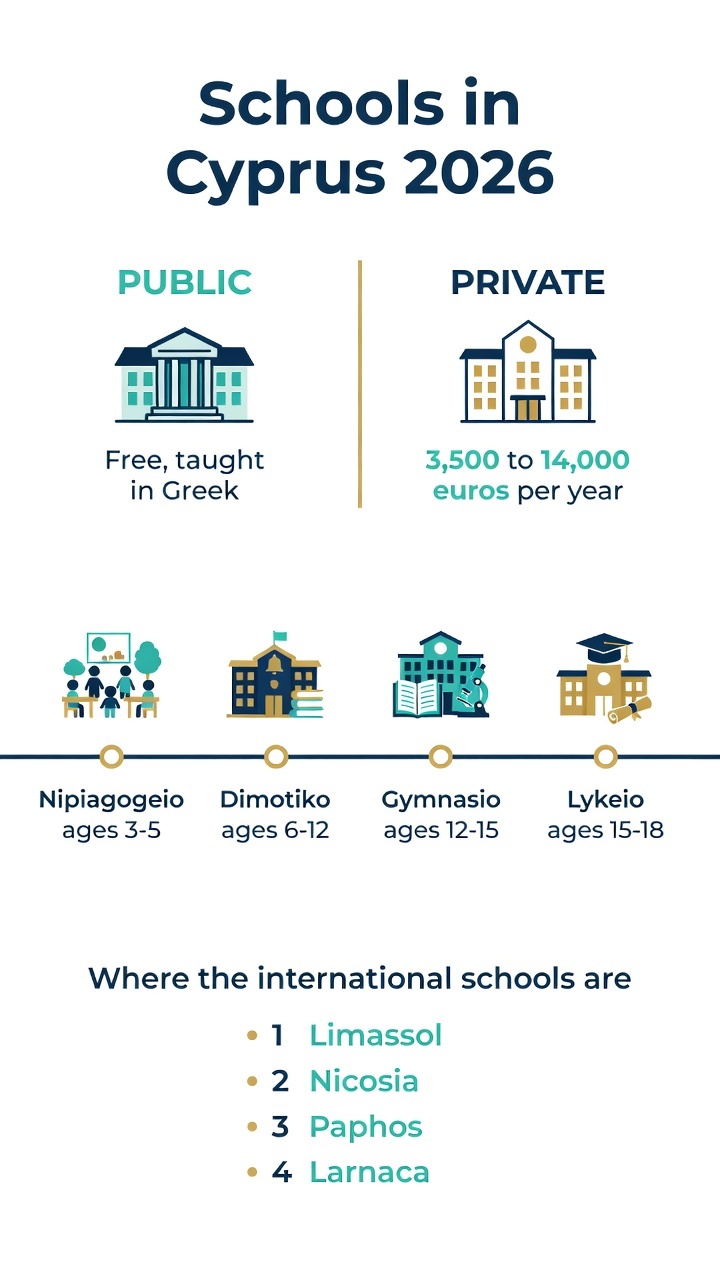
Some concrete published figures give the range shape. PASCAL Lefkosia lists €8,000 for lower primary rising to €9,825 for upper secondary, with IB Diploma years at €11,485. Foley’s in Limassol lists €11,700 for Forms 1–3 and €12,600 for Forms 4 to Upper Sixth. The Grammar School Limassol publishes €8,700 to €10,650 across its year groups at the non-Cypriot-citizen rate — and that qualifier matters, because several schools operate two fee schedules, with Cypriot passport holders paying less. TLC Private School in Paphos runs €4,095 to €8,395, at the more accessible end.
Tuition is not the whole number, and the gap catches people out. Budget separately for:
Two structural points are worth knowing before you commit. Sibling discounts are near-universal, generally 8% to 20% for a second child and steeper for a third. And fees escalate annually — schools variously cap increases at 5% or 8%, so a child entering reception should be modelled at meaningfully more by sixth form.
One cash-flow trap deserves flagging. Foley’s requires full annual payment in advance from anyone who is not a Cypriot citizen or a long-term property-owning resident. Fees are also generally non-refundable and non-transferable, including if you leave mid-year. For a family arriving on a relocation package, that is a large upfront sum landing at the same moment as rental deposits and moving costs — worth building into your budget alongside the other costs of living in Cyprus.
For an outside perspective on how the Cyprus system approaches learning, this analysis is a useful counterpoint to school marketing material:
Where the international schools cluster is not evenly distributed, and this is the fact that should shape your property search most directly.
Limassol has the densest concentration of English-medium and international schools on the island, driven by the shipping cluster, the forex and CFD sector, and the relocated tech companies. The established options include The Heritage Private School at Palodia, Foley’s, The Grammar School Limassol, and Logos School of English Education — all British-curriculum, running Cambridge or Pearson Edexcel IGCSE and A Level.
The Island Private School is the outlier and the only full IB Continuum school in Cyprus, offering PYP, MYP, DP and CP across campuses at Palodia, Parekklisia and Sunset Gardens, the last of which offers boarding from Year 7. PASCAL operates three Limassol campuses, having opened a City Centre campus running the IB Primary Years Programme in September 2025.
The trade-off is cost. Limassol is the most expensive district for both schooling and housing, and places are the hardest to secure. If you are weighing it up, our guide to living in Limassol covers the wider picture, and you can browse current property for sale in Limassol to see what the school catchment areas actually cost.
The capital is second by volume but distinct in character, because the diplomatic community shapes what is on offer. The American International School in Cyprus is the genuinely American option, running a US college-prep diploma alongside the IB Diploma in the final two years. The École franco-chypriote de Nicosie delivers the French national curriculum under AEFE supervision.
The English School in Strovolos is the island’s most historically prestigious institution, following the National Curriculum for England with competitive entrance examinations. The American Academy Nicosia — British-curriculum despite the name — became an IB World School in September 2025. PASCAL Lefkosia is an authorised IB Diploma school and also runs a boarding programme.
Nicosia is inland, so you trade sea access for lower prices and shorter commutes. Property for sale in Nicosia generally represents better value per square metre than the coast.
Paphos serves a long-established British resident community alongside a growing Russian-speaking population. The International School of Paphos, founded in 1987, is co-educational with boarding and runs IGCSE through to A Level. TLC Private School follows the National Curriculum for England from kindergarten to Key Stage 5. Lumio Private School became Paphos’s first IB World School for the Middle Years Programme in June 2026.
Prices are materially lower than Limassol, which is why families who can work remotely often land here. See living in Paphos and current property for sale in Paphos.
Larnaca’s provision is thinner but growing, anchored by The American Academy Larnaca — British-style from ages 2 to 18, with a parallel Greek School track — and PASCAL Larnaka, an authorised IB World School. Larnaca offers the shortest airport commute on the island, which matters if one parent travels weekly. Property for sale in Larnaca sits between Paphos and Limassol on price.
Famagusta district has effectively no international provision, so families relocating there generally commute to Larnaca.
The British curriculum overwhelmingly dominates the private sector in Cyprus. Cambridge International and Pearson Edexcel IGCSE, GCSE, AS and A Level qualifications are offered by the large majority of the schools named above. If your children are arriving mid-way through a UK education, the transition is close to seamless.
The International Baccalaureate has a solid and expanding footprint, present in Cyprus since 1994 across roughly ten IB World Schools. Availability by programme currently means the Diploma at PASCAL Lefkosia and Larnaka, AISC and the American Academy Nicosia; the Primary Years Programme at PASCAL Lemesos City Centre; the Middle Years Programme at Lumio in Paphos; and the full continuum only at The Island Private School. Because authorisations change year to year, verify the current status directly with the school before committing.
Genuinely American programmes are narrow — AISC in Nicosia is effectively the only full US college-prep option. French is available through the École franco-chypriote. Several Russian-curriculum schools operate in Nicosia, Limassol and Paphos, though this segment has been volatile since 2022 and current operating status should be confirmed individually.
For structural comparison with other European systems, the European Commission’s Eurydice profile of Cyprus is the standard reference.
This is where relocating families most often get caught out, because demand has risen sharply. Ministry figures reported in January 2026 show foreign enrolment in private primary schools growing from around 1,900 to more than 4,500 pupils over a decade, and private secondary from around 1,100 to more than 4,200. The Cyprus Mail’s reporting documents the resulting expansion push, including a government incentive scheme under which 28 schools applied for planning concessions to build capacity.
Waiting lists are now the norm rather than the exception at sought-after schools. The practical implications:
That address requirement creates a genuine sequencing problem: some schools want a Cyprus address before confirming a place, while you would reasonably prefer to know the school before signing a lease. The common solution is a short-term or six-month rental in the target district, converting to a purchase once the school place is confirmed and the commute has been tested through a real winter. Our guide to renting property in Cyprus covers how those contracts work.
A few patterns hold consistently across the island.
If you are still choosing between districts, our comparison of the best places to live in Cyprus works through the wider trade-offs, and the guide to relocating to Cyprus covers residency, banking and the rest of the sequence.
Public schools in Cyprus are free, genuinely open to everyone, and an excellent route for younger children — with the caveat that Greek-language support varies sharply by individual school. Private and international schools in Cyprus run roughly €3,500 to €14,000 per year before extras, with the extras adding meaningfully to that. Limassol has the deepest international provision and the highest prices; Nicosia has the American and French options; Paphos and Larnaca cost less with fewer choices.
Apply early, budget for the costs beyond tuition, and rent before you buy. Choose the school, then let it tell you where to live — index.cy lists more than 60,000 verified properties across all five districts, so once you know the catchment, the search gets a great deal simpler.