
For most families relocating to Cyprus, the school decision comes first and the property decision follows about a week later. That order matters more in Limassol than anywhere else on the island, because the private schools in Limassol are not clustered in one convenient district. They are spread from Mesa Geitonia to the hills of Palodeia, and the campus you choose quietly determines which neighbourhoods make sense to live in, what your morning commute looks like, and how much you will pay per square metre.
This guide covers what private schools in Limassol actually cost in 2026, which curricula are available, where the main campuses sit on the map, and how to line all of that up with a realistic property search. If you want the island-wide picture first, our guide to schools in Cyprus covers the public system, the national structure and the other districts.
Limassol is Cyprus’ commercial capital, and the education market has followed the money. Shipping, fintech, forex and professional services have brought a large, well-paid international workforce to the city, and those families overwhelmingly educate their children in English. The result is a concentration of English-medium private education you do not find in Larnaca, Paphos or even Nicosia.
The International Schools Database currently lists 13 international schools in Limassol. Add the long-established Greek-and-English private schools that predate the recent expat wave, and parents are realistically choosing between a dozen or more genuine options — from institutions founded in the 1970s and 1980s to campuses that opened in the last few years with a very different educational philosophy.
That choice is a real advantage. It also means the “obvious” school is rarely obvious, and that two families with similar budgets can end up living 15 kilometres apart because they picked differently.
Published tuition for private schools in Limassol generally runs between roughly €5,500 and €14,000 per year, with the position within that range driven more by year group than by prestige. Early years and primary sit at the bottom; upper secondary, where students are sitting IGCSEs and A Levels, sits at the top.
Here is what published figures look like for a mid-primary entry point, which is the most common relocation scenario:
| School | Indicative annual tuition | Typical first-year extras |
|---|---|---|
| American Academy Limassol | ~€6,798 | ~€500 application and registration |
| PASCAL Lemesos | ~€8,335 | €750 registration (annual) + €50 PTA |
| Foley’s School | ~€9,300 | €1,800 refundable deposit |
| The Grammar School | ~€5,680–€10,100 (range across years) | Varies by year group |
| The Heritage Private School | ~€5,500 (lower) to €13,000–€14,000 (upper) | Varies by year group |
| The Island Private School | ~€11,750 first year (age 3, incl. one-off enrolment) | Bundled into first-year figure |
Figures are indicative published rates for the 2026–27 cycle and are shown for comparison, not as quotations. Fee structures change annually — always confirm directly with the school.
Two things consistently surprise newly arrived parents.
First, tuition is not the bill. Registration fees, refundable deposits, capital levies, technology charges and “composite” fees typically add somewhere between €300 and €1,900 in year one. A €9,300 tuition figure can become an €11,100 cash outlay before the first term starts.
Second, the deposit is not always a fee. Some schools take a substantial refundable deposit rather than a non-refundable levy. That is far better for you financially, but it changes your cash-flow planning in exactly the month you are also paying property transfer fees and moving costs.
If you are budgeting the whole move rather than just the school run, our cost of living in Cyprus guide puts these numbers next to groceries, utilities and healthcare.
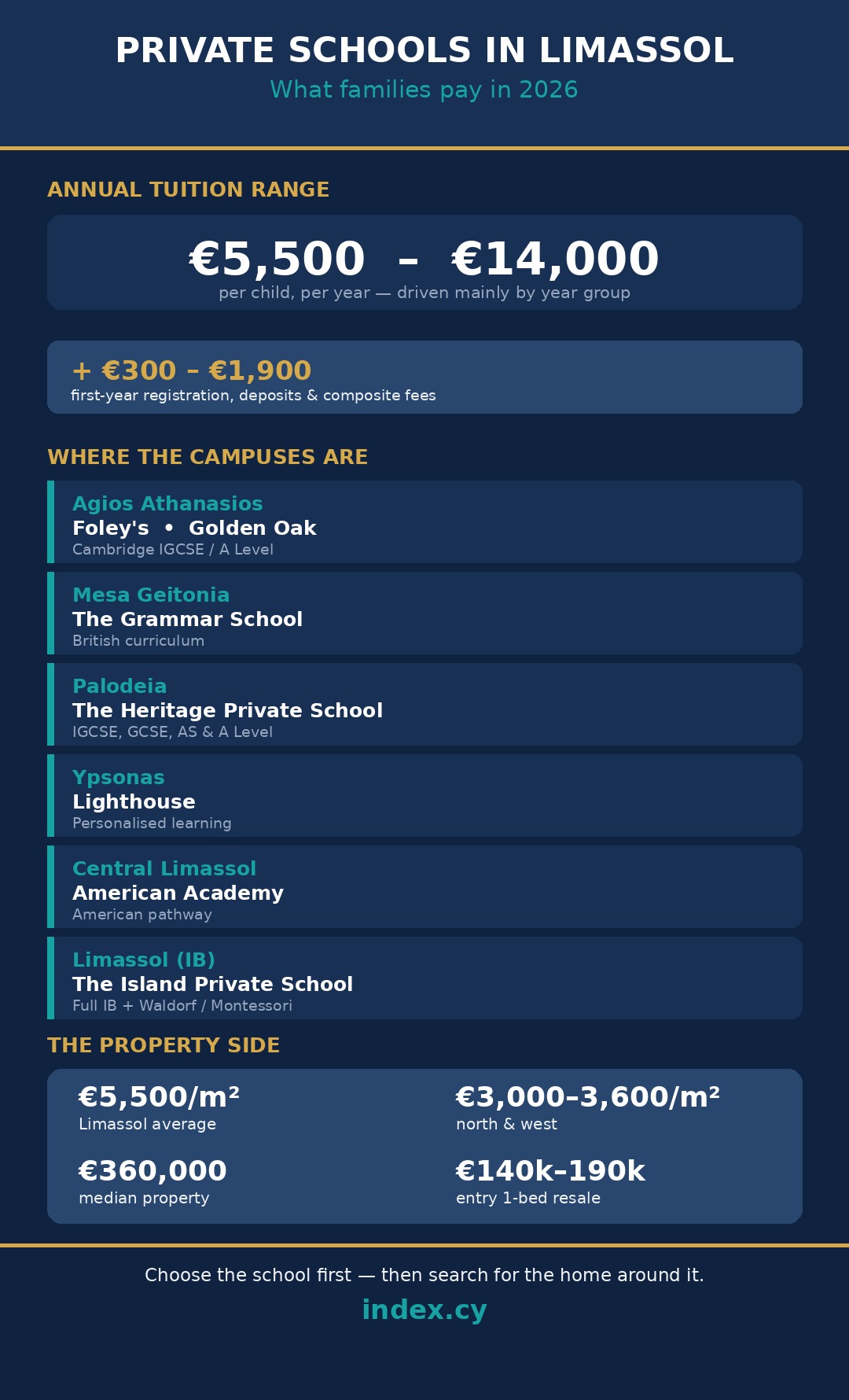
Location is the single most underrated variable in this decision. Here is roughly how the map works.
Agios Athanasios has become the strongest school cluster in the city. Foley’s School has occupied purpose-built facilities here since 2016, offering the UK National Curriculum through Cambridge IGCSE and A Level. Golden Oak Private School sits on the hills above the same area as a licensed Cambridge International School. For families, Agios Athanasios is the closest thing Limassol has to a school district.
Mesa Geitonia is home to The Grammar School, one of the city’s long-established British-curriculum institutions, and sits close enough to the centre to work for parents commuting into the business district.
Palodeia — roughly five kilometres north of the motorway — hosts The Heritage Private School, an English-medium school of around 1,400 pupils offering Cambridge IGCSE, GCSE, AS and A Levels. This is a genuinely inland location, and it pulls a share of Limassol’s family buyers up into the hill villages rather than the coast.
Ypsonas, to the west, hosts Lighthouse, one of the newer schools focused on personalised learning. Ypsonas is also one of the more affordable parts of the Limassol market, which makes it a practical pairing.
Central Limassol retains the American Academy, which opened in 1986 and moved its primary section to its current Lefkas Street location in 1990 as enrolment grew.
The practical takeaway: a family choosing Heritage and a family choosing the American Academy are shopping in two different property markets, at two different price points, with two different commutes.
Curriculum choice is where the schools genuinely differentiate, and it is worth deciding before you tour campuses.
British (Cambridge IGCSE and A Level) is the default and the deepest pool. Foley’s, Heritage, The Grammar School and Golden Oak all operate in this space. If your children are arriving mid-education from the UK or from a British-curriculum school elsewhere, this is the lowest-friction transition, and Cambridge International qualifications are recognised by universities worldwide.
International Baccalaureate is far rarer here. The full IB continuum in Limassol is offered at The Island Private School, which blends IB with Waldorf and Montessori frameworks — a distinctly progressive model rather than a traditional one. If IB is non-negotiable for you, your school shortlist is short, and your property search should start from that campus outward.
American curriculum is represented by the American Academy, leading to university entrance along a US-style pathway.
Greek-medium public schools remain free, open to everyone including EU and non-EU residents, and are the route many long-staying families eventually take for younger children who pick up the language quickly. The Cyprus Ministry of Education, Sport and Youth oversees the public system and the registration of private schools.
There is no universally correct answer here. A family planning to stay three years and return to London should weigh continuity heavily. A family intending to settle permanently should weigh integration and language just as heavily.
The most common relocation mistake in Limassol is treating school admission as a formality that follows the house purchase. In practice it works the other way round.
The strongest schools in the popular year groups do run waiting lists, and places open unpredictably as other expat families rotate out of the island. Assessments, interviews and previous school reports are standard, and places are not usually held open for months while you complete a property transaction.
A realistic sequence looks like this:
Our guide to renting property in Cyprus covers contracts and deposits. If you are still working through visas and paperwork alongside this, the relocating to Cyprus guide and the Cyprus yellow slip guide cover the registration side, and the working in Cyprus guide covers permits and salaries.
This is where school choice becomes a property decision. Limassol is the most expensive district in Cyprus, and the spread within the city is wide enough that your campus choice can move your budget by hundreds of thousands of euros.
Across Limassol, the average price sits at roughly €5,500 per square metre, with an apartment median nearer €4,300 per square metre. Premium seafront and marina locations run to €7,000–€9,000 per square metre, while northern and western neighbourhoods start from around €3,000–€3,600. The median property price is about €360,000, though the average climbs to roughly €520,000 because luxury seafront towers pull the figure upward. Prices have risen around 6–8% over the past year.
Apartments make up roughly 70% of Limassol’s residential stock, with detached houses at about 25% and villas at 5% — which matters, because families wanting a garden are competing for a genuinely limited slice of the market.
Practical pairings:
For a broader view of how the districts compare before you commit, see our property prices in Cyprus guide and the living in Limassol guide. You can browse current properties for sale in Limassol by area and price on index.cy, and run an instant property report on anything you shortlist to see how the asking price compares with the surrounding market.
It is worth doing this arithmetic before you fall in love with a campus.
Two children in mid-primary at a mid-range Limassol private school costs roughly €14,000–€18,000 a year in tuition alone, before extras, uniforms, transport and activities. Push both into upper secondary at a top-of-range school and that figure can approach €28,000.
Now layer on housing. A three-bedroom family home in the Agios Athanasios or Palodeia catchments will sit meaningfully above the city’s €360,000 median. Financing that alongside €15,000-plus of annual school fees is the actual constraint most relocating families hit — not the availability of good schools.
Two consequences follow, and both are worth planning for deliberately:
If you are buying as a non-EU national, our guide to buying property in Cyprus as a foreigner covers the permit step that applies before transfer.
Published tuition generally runs from about €5,500 to €14,000 per year depending on the school and, more importantly, the year group. Budget an additional €300–€1,900 in first-year registration, deposit and composite fees.
Yes, but very few. The full IB continuum in Limassol is offered at The Island Private School, which combines IB with Waldorf and Montessori approaches. Most other English-medium schools in the city follow the British Cambridge pathway to IGCSE and A Level.
Not strictly — several schools operate bus services and many families drive. But Limassol traffic at 7:45am is real, and the difference between a 10-minute and a 35-minute school run twice a day compounds fast. Most families end up prioritising proximity more than they expected to.
Yes. Public schools are free and open to residents regardless of nationality. Instruction is in Greek, which younger children typically absorb quickly and teenagers often find difficult mid-education. Many families use private education initially and reassess later.
Rent first if you can. Six to twelve months in a rental near your chosen campus tells you whether the commute, the neighbourhood and the school are right before you commit several hundred thousand euros to a purchase.
Limassol offers the deepest choice of private schools in Cyprus — around a dozen serious options, most of them English-medium, spanning the British curriculum, the IB and an American pathway, at published fees of roughly €5,500 to €14,000 a year.
The decision that matters, though, is not simply which school is best. It is which school, in which location, at which combined cost of tuition and housing, works for your family over the next five years. The campuses are scattered across the city and its inland villages, and the property markets around them differ by thousands of euros per square metre.
Choose the school first, verify the place is genuinely available, then search for a home around it. Start with current properties for sale in Limassol on index.cy, filter by the catchment that fits your shortlist, and check any serious candidate with an instant property report before you make an offer.
This guide is for general information and reflects published figures at the time of writing. School fees, availability and admissions requirements change — confirm current details directly with each school before making financial commitments.