
What this guide covers
- Why Owning a Car in Cyprus Makes Sense
- New, Used, or Imported? Choosing How to Buy
- Where to Find Cars for Sale in Cyprus
- How to Transfer Ownership and Register a Used Car
- What It Costs to Own a Car in Cyprus
- Importing a Car to Cyprus: Duty, VAT, and the TOR Exemption
- A Buyer’s Checklist Before You Pay
- Frequently Asked Questions
- Can foreigners buy a car in Cyprus?
- Which side of the road does Cyprus drive on?
- How much does it cost to transfer a car in Cyprus?
- Is it cheaper to buy locally or import a car?
- Getting on the Road
Buying a car in Cyprus is one of the first practical steps most new residents take, and for good reason. Public transport covers the main towns but thins out fast once you leave the centre, so a car is what turns a Cyprus address into a workable daily life. The process is straightforward once you understand it, yet it catches out newcomers who assume it works exactly like their home country. It doesn’t. Cyprus drives on the left, taxes vehicles by emissions, and runs its own registration system.
This guide walks you through every stage: where to find cars, how to transfer ownership, what registration and road tax actually cost, and the rules that apply if you want to import a vehicle instead. Whether you’re relocating for work, retiring to the coast, or settling in after buying property, here’s what you need to know before you hand over any money.
Why Owning a Car in Cyprus Makes Sense
Cyprus is a car-dependent island. Intercity buses connect Limassol, Nicosia, Larnaca, and Paphos, and urban routes run within each town, but services are infrequent by Northern European standards and stop early in the evening. There is no rail network at all. For most residents, a car isn’t a luxury—it’s the difference between reaching a supermarket, a school, or a beach on your own schedule.
The good news is that running costs are moderate. Fuel is cheaper than in most of Western Europe, distances are short, and annual ownership costs for a modest used car are low. If you’re still weighing up where to settle, factor transport into your budget alongside rent and utilities. Our cost of living in Cyprus breakdown puts car ownership in context with the rest of your monthly spending.
One rule matters above all others: Cyprus drives on the left, British-style, with the steering wheel on the right. Right-hand-drive cars dominate the local market, which is convenient if you’re arriving from the UK and awkward if you’re bringing a left-hand-drive vehicle from mainland Europe.
New, Used, or Imported? Choosing How to Buy
You have three realistic routes to a car in Cyprus, and the right one depends on your budget, how long you’re staying, and whether you already own a suitable vehicle abroad.
Buying a used car locally is by far the most common choice for new arrivals. The car is already registered, road-legal, and priced in euros, so you avoid customs paperwork entirely. Buying new from a dealership costs more but comes with a warranty and zero history to worry about. Importing your existing car can make sense if it’s valuable, right-hand drive, and you qualify for a tax exemption—but it involves the most bureaucracy.
Here’s how the three options compare:
| Option | Best for | Typical effort | Key cost factors |
|---|---|---|---|
| Used car (local) | Most new residents | Low | Purchase price, transfer fee, road tax, MOT |
| New car (dealer) | Long-term residents wanting a warranty | Low | Higher purchase price, dealer handles paperwork |
| Imported car | Owners of valuable right-hand-drive vehicles | High | Shipping, customs, registration tax, VAT (if applicable) |
For anyone staying a year or two, a used local car almost always wins on simplicity and cost. Reserve importing for cases where the vehicle is genuinely worth the effort.
Where to Find Cars for Sale in Cyprus
The Cyprus used-car market runs largely online, and one platform dominates. Bazaraki is the island’s number-one classifieds site, listing thousands of cars from both private sellers and dealers—it’s the natural place to start your search. Facebook Marketplace is the second major channel, especially for private sales and expat-to-expat deals.
Beyond the classifieds, you’ll find independent dealerships in every town and franchised showrooms for new vehicles. Each route carries a different trade-off:
- Private sellers usually offer the lowest prices, but the entire burden of inspection and history checking falls on you. There’s no warranty and no comeback if something goes wrong.
- Independent dealers cost a little more but often handle the transfer paperwork and may include a short three-to-six-month warranty on the engine and gearbox.
- Franchised new-car showrooms offer full manufacturer warranties and finance, at the highest price point.

If you’re arriving after relocating to Cyprus, it’s worth spending your first week or two using local buses while you research the market rather than rushing into the first listing you see. Prices vary widely between private and dealer sales for the same model.
This short walkthrough covers the practical side of finding and buying a car once you’ve arrived on the island:
How to Transfer Ownership and Register a Used Car
Transferring a used car into your name is refreshingly simple compared with property. The change of keeper is handled by the Department of Road Transport or at a Citizen Service Centre (KEP), and both the buyer and seller need to take part—in person or through a signed proxy.
The core requirements are straightforward. Before the transfer can be completed, the car must have:
- Valid insurance in place (you arrange cover in the buyer’s name).
- A valid MOT certificate confirming the car is roadworthy.
- A completed transfer form, signed by both parties.
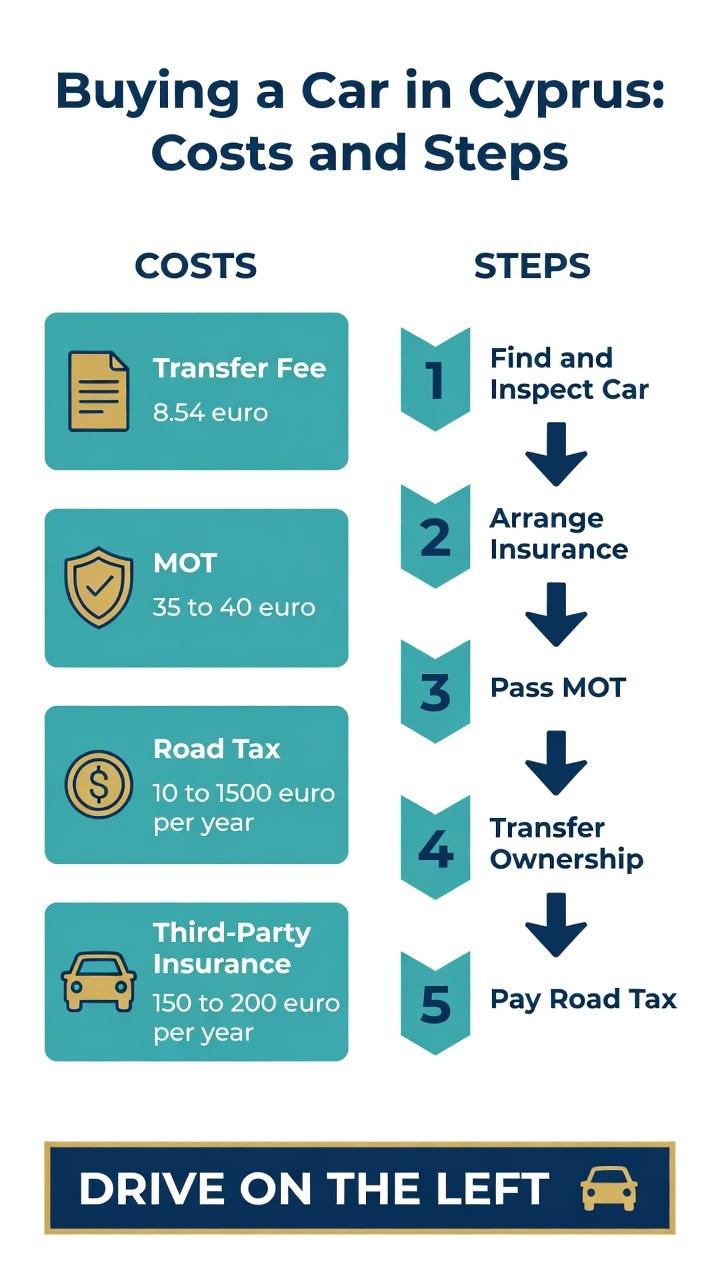
You then pay a small transfer fee—currently around €8.54—and a new registration document is issued in your name. That’s it. Unlike buying property, there’s no lawyer, no title search, and no lengthy waiting period.
That said, the paperwork protects the seller, not the buyer. Make your inspection and history checks before you sign, because once ownership transfers, any hidden faults become your problem. Note too that you can’t legally drive the car home without insurance already active, so line up cover before completion day.
What It Costs to Own a Car in Cyprus
The purchase price is only the start. Three recurring costs—road tax, MOT, and insurance—determine what your car actually costs to keep on the road each year. The encouraging news is that for a typical small or mid-size used car, the total is modest.
Road tax (officially the Circulation Licence) is where the numbers swing most. Cyprus charges it based on emissions and registration date. Cars first registered before 2014 are taxed on engine size; those registered from 2014 onward are taxed on CO2 emissions. The annual bill ranges from around €10 to €1,500. Older diesels are penalised hardest: a ten-year-old diesel registered after 2019 can carry a €1,000 age surcharge, versus €500 for an equivalent petrol car. Choosing a low-emission petrol vehicle keeps this cost down significantly.
MOT (roadworthiness test) is inexpensive. It costs €35 at a private IKTEO centre or €40 at a public KEMO centre. A private car takes its first test at four years old, then every two years, moving to annual testing once it passes ten years.
Insurance starts low. Third-party liability cover runs roughly €150–€200 per year depending on your age, experience, and the vehicle. Comprehensive cover on a higher-value car can exceed €1,000.
| Cost | Typical annual figure | Notes |
|---|---|---|
| Road tax (Circulation Licence) | €10 – €1,500 | Emissions and registration-date based; low for small petrol cars |
| MOT test | €35 (IKTEO) / €40 (KEMO) | First test at 4 years, then every 2 years |
| Third-party insurance | €150 – €200 | Comprehensive cover costs more |
| Total (small used car) | ~€250 – €600 | Excludes fuel and repairs |
For most residents, then, a modest used car costs somewhere between €250 and €600 a year to run before fuel and maintenance. If you’re already budgeting for home insurance in Cyprus, it’s sensible to treat car cover as part of the same annual planning.
Importing a Car to Cyprus: Duty, VAT, and the TOR Exemption
Bringing your own car can be worthwhile, but it’s the most paperwork-heavy route. The rules split sharply depending on where the car comes from.
A vehicle already in free circulation within the EU generally attracts no import duty. A car coming from outside the EU may face import duty of up to 10% plus 19% VAT on its CIF (cost, insurance, freight) value, cleared through the Cyprus Customs & Excise Department. On top of any duty or VAT, Cyprus applies a CO2-based registration tax.
The single biggest cost lever is the Transfer of Residence (TOR) exemption. If you’re relocating and meet the qualifying conditions, TOR can waive both duty and VAT—turning a potentially expensive import into a manageable one. It’s the reason many people moving from the UK bring their car rather than sell it.
The registration process itself runs in sequence: clear customs (forms C1040 and C72A), pass Single Vehicle Approval and a roadworthiness inspection at the Department of Road Transport, arrange Cyprus insurance, then collect your plates. Budget roughly €1,250 to €3,500 in fixed shipping, clearance, and registration costs, plus any duty or VAT that applies.
Before importing, confirm you also hold the right to drive locally. Our Cyprus driving licence guide explains when you can use a foreign licence and when you must exchange it.
A Buyer’s Checklist Before You Pay
A used car in Cyprus is bought “as seen,” so your inspection is your only real protection. Whether you’re viewing a private sale or a dealer’s forecourt, run through the essentials before you commit:
- Documents: Confirm the seller’s name matches the registration document, and check the car has a valid, current MOT.
- Exterior: Look for mismatched paint, rust, dents, and any signs of collision repair.
- Interior: Check seat wear, that all dashboard warning lights clear on start-up, and that the electronics work.
- Engine bay: Inspect for leaks, unusual odours, and signs of neglect.
- Undercarriage: Watch for rust, oil leaks, or structural damage.
- Test drive: Listen for gearbox and suspension noise, and make sure the brakes pull evenly.
If you’re not confident assessing a car yourself, a dealer with a short warranty is worth the premium for the peace of mind. For a valuable purchase, paying a local mechanic for a pre-purchase inspection is money well spent.
Frequently Asked Questions
Can foreigners buy a car in Cyprus?
Yes. There are no nationality restrictions on owning a car in Cyprus. You need a local address for registration and valid insurance, but you don’t need citizenship or permanent residency to buy and register a vehicle in your name.
Which side of the road does Cyprus drive on?
Cyprus drives on the left, following the British system, with the steering wheel on the right. This makes right-hand-drive cars—including UK imports—the natural fit for the local market.
How much does it cost to transfer a car in Cyprus?
The ownership transfer fee is small, currently around €8.54, paid at the Department of Road Transport or a Citizen Service Centre. The car must have valid insurance and a valid MOT before the transfer can be completed.
Is it cheaper to buy locally or import a car?
For most people, buying a used car locally is cheaper and far simpler, because you avoid customs and registration paperwork. Importing only makes financial sense for valuable right-hand-drive cars, and especially when you qualify for the TOR exemption that waives duty and VAT.
Getting on the Road
Buying a car in Cyprus comes down to three decisions: choosing between a local used car, a new dealer purchase, or an import; budgeting for road tax, MOT, and insurance; and inspecting carefully before you pay. Get those right and you’ll have reliable transport for a few hundred euros a year in running costs.
Take your time with the search, verify the paperwork, and never skip the pre-purchase checks. A car is what makes island life practical—reaching the districts, the coast, and the day-to-day errands that a bus timetable can’t. If you’re still settling in, our guides to living in Cyprus as an expat and moving to Cyprus from the UK cover the wider practicalities of building a life here, from healthcare to housing. And when you’re ready to put down roots, browse verified listings across Limassol and Paphos on Cyprus’ number-one property marketplace.
Keep reading

We analysed 249 Kouklia, Paphos listings: 210 houses, 20 plots and 6 apartments. Median 2-bed house asks EUR397,000. See prices, plots and…

We analysed 217 Erimi, Limassol listings: 105 apartments, 81 houses and 24 plots. Median 2-bed flat EUR295,000. See prices, the repeat-advert trap…

We analysed 319 Aglantzia, Nicosia listings: 155 apartments, 34 houses and 38 plots. Median 2-bed costs EUR257,500. See prices, rents and what…