
What this guide covers
- What Cyprus Citizenship Actually Gives You
- Can You Still Get Cyprus Citizenship by Investment?
- Cyprus Citizenship by Naturalisation: The Standard Route
- Fast-Track Naturalisation for Skilled Professionals
- Citizenship Through Marriage and Descent
- Citizenship by Marriage
- Citizenship by Descent
- The Property Route: From Purchase to Passport
- Documents, Costs, and How to Apply
- Is the Cyprus Passport Worth Pursuing?
Cyprus citizenship gives you a full European Union passport, visa-free travel to more than 170 countries, and the right to live, work, and study anywhere in the EU. For property buyers, expats, and investors already building a life on the island, becoming a Cypriot citizen is often the final step in a longer journey that starts with a home and permanent residence.
But the rules changed significantly after 2020. The old “golden passport” scheme that let wealthy investors buy citizenship outright is gone. Today, Cyprus citizenship is earned through lawful residence, integration, and time on the island. This guide explains every current route to a Cyprus passport in 2026, what you need to qualify, how the property-to-citizenship path works, and the documents and costs involved.
We’ll keep it clear, accurate, and grounded in the latest legislation—so you can plan your path with confidence.
What Cyprus Citizenship Actually Gives You
A Cypriot passport is one of the most valuable in the world because Cyprus is a full member of the European Union. Once you hold it, you gain rights that permanent residence alone cannot offer.
As a Cyprus citizen, you can live, work, study, and retire in any of the 27 EU member states without a visa or permit. You get visa-free or visa-on-arrival access to over 170 destinations, including the UK, Canada, Japan, and Singapore. You can vote in Cypriot and European elections, and you hold your status for life—there is no renewal, no minimum stay, and no risk of losing it if you move abroad.
Dual citizenship is fully permitted. You do not have to give up your existing nationality to become Cypriot, which makes the passport especially attractive to expats from the UK and beyond who want to keep their British citizenship while gaining EU rights.
For families, citizenship passes to your children, creating a lasting legacy. A Cypriot passport also carries no obligation to physically stay in the country once granted—unlike some residence permits, which can lapse if you spend too long abroad. This permanence is the key difference between citizenship and residency, and it’s why many buyers who start with a property purchase eventually pursue naturalisation.
It’s worth being clear about the distinction early. Permanent residence lets you live in Cyprus indefinitely, but it does not give you an EU passport, the right to work freely across the bloc, or a vote. Citizenship does all three. For serious long-term movers, that gap is the whole reason to keep going after the residence stage.
Can You Still Get Cyprus Citizenship by Investment?
This is the most common question we hear, and the answer is clear: no, you cannot buy Cyprus citizenship directly anymore.
Cyprus abolished its Citizenship by Investment programme on 1 November 2020. The scheme had allowed investors to obtain a passport in exchange for a real estate investment of around €2 million, but it was scrapped after a series of transparency scandals and pressure from the European Commission.
Since then, there is no fast, purely financial route to a Cypriot passport. Any website or agent promising “Cyprus citizenship by investment” in 2026 is either outdated or misleading.
What remains is the Cyprus Golden Visa, officially the Investor Immigration Permit. This grants permanent residence—not citizenship—to investors who buy at least €300,000 of qualifying new property. Permanent residence is a valuable status in its own right, and crucially, it can serve as the foundation for citizenship later through naturalisation.
So while you can’t purchase a passport, your property investment can still put you on the path to one. You can explore that route in detail in our Cyprus Golden Visa guide.
Cyprus Citizenship by Naturalisation: The Standard Route
Naturalisation based on years of residence is the main pathway to Cyprus citizenship for most foreign nationals. It rewards people who genuinely live on the island and integrate into Cypriot society.
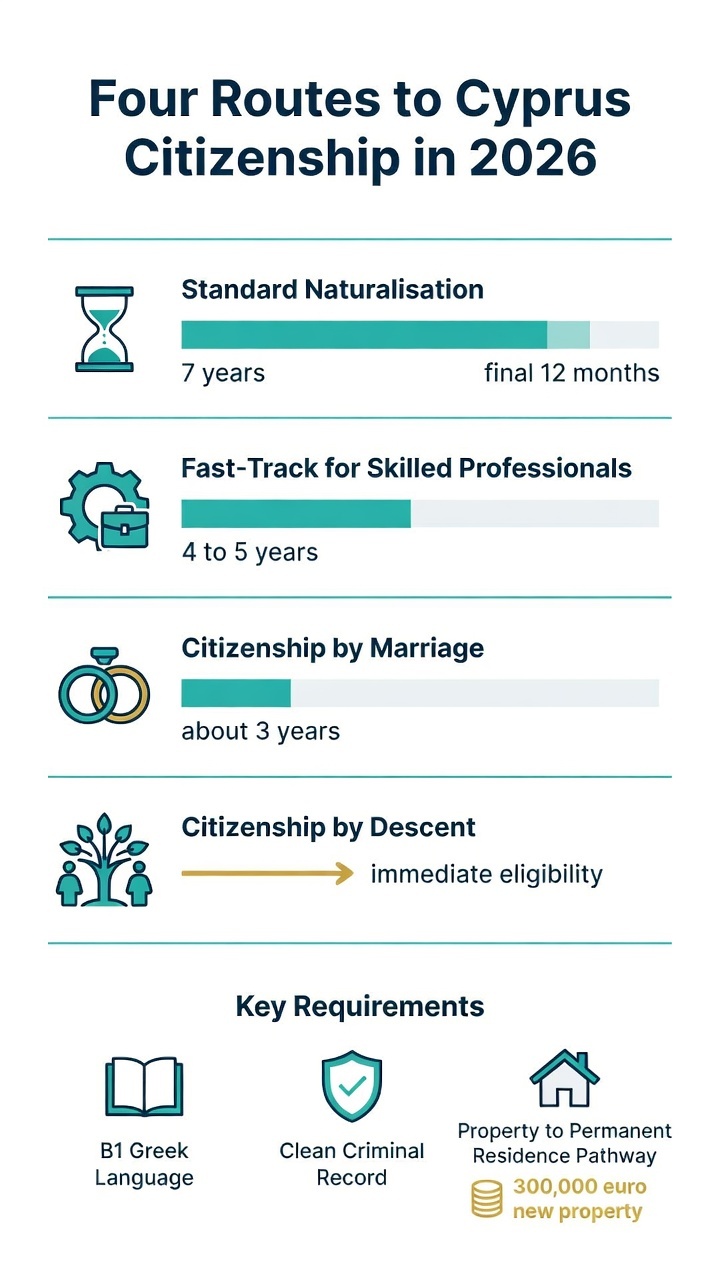
Under the standard route, you must complete eight years of lawful residence in Cyprus. In practice, this means seven years of legal stay within the previous ten years, plus a continuous twelve months immediately before you apply. During that final year, your absences from Cyprus must not exceed 90 days.
Beyond the time requirement, applicants must meet several integration criteria:
- **Greek language proficiency** at B1 level (lower-intermediate), shown through a recognised certificate
- **Knowledge of Cypriot culture, history, and society**, tested as part of the application
- A **clean criminal record** in Cyprus and your home country
- Proof of **good character** and stable finances
- Continuous, lawful residence throughout the qualifying period
The eight-year clock counts time spent as a legal resident—whether you hold a work permit, a residence permit as an EU citizen, or permanent residence obtained through property investment. If you’re building toward this from abroad, our relocating to Cyprus guide explains how to establish that lawful residence from day one.
One point that surprises many applicants: the residence must be genuine and continuous, not just a permit held on paper. Immigration officers assess whether Cyprus is truly your centre of life. That means maintaining a home on the island, spending most of the year there, and integrating locally. Buyers who purchase a property, move in, and put down real roots are in a far stronger position than those who treat residence as a paperwork exercise. Minor children who live in Cyprus with a naturalising parent can often be included in or benefit from the process, which is why families frequently plan the timeline around their move together.
Fast-Track Naturalisation for Skilled Professionals
In late 2023, Cyprus introduced a faster naturalisation route to attract talent, and it remains one of the most important changes for professionals in 2026. Published in the Official Gazette on 19 December 2023, the amendment to the Civil Registry Law created a structured, shorter path for highly skilled employees.
Under this route, the qualifying period drops dramatically:
- **Four years of lawful residence** if you hold a B1 Greek language certificate
- **Five years of lawful residence** if you hold an A2 (elementary) Greek certificate
To qualify, you must be employed by an approved “company of foreign interests” registered with the Business Facilitation Unit of the Ministry of Energy, Commerce and Industry. You need to have worked for that company for at least two years before applying, and earn a gross salary of at least €2,500 per month.
This fast-track has made Cyprus one of the quickest routes to an EU passport for skilled workers in tech, finance, shipping, and professional services—sectors that have driven strong demand for apartments for sale in Cyprus, particularly in Limassol and Nicosia. Family members of qualifying professionals may also benefit from differentiated naturalisation conditions.
Citizenship Through Marriage and Descent
Not everyone reaches Cyprus citizenship through years of residence. Two other established routes apply to specific situations.
Citizenship by Marriage
If you are married to a Cypriot citizen, you can typically apply for naturalisation after three years of marriage, provided you have been living in Cyprus. The couple must demonstrate a genuine, ongoing relationship, and the applicant must still meet good-character and clean-record requirements. Exact conditions can vary depending on how long the couple has lived on the island, so it’s wise to confirm current details with the authorities before applying.
Citizenship by Descent
Cyprus recognises citizenship by descent for people with Cypriot heritage. If you have a parent or, in some cases, a grandparent who is or was a Cypriot citizen, you may be entitled to register as a citizen rather than go through naturalisation. This route is based on birthright rather than residence, so the years-of-stay rules don’t apply.
Both routes still require careful documentation, but they can be far quicker than the standard eight-year path for those who qualify.
The Property Route: From Purchase to Passport
For most international buyers, the realistic path to Cyprus citizenship runs through property and permanent residence. Here’s how the journey typically works.
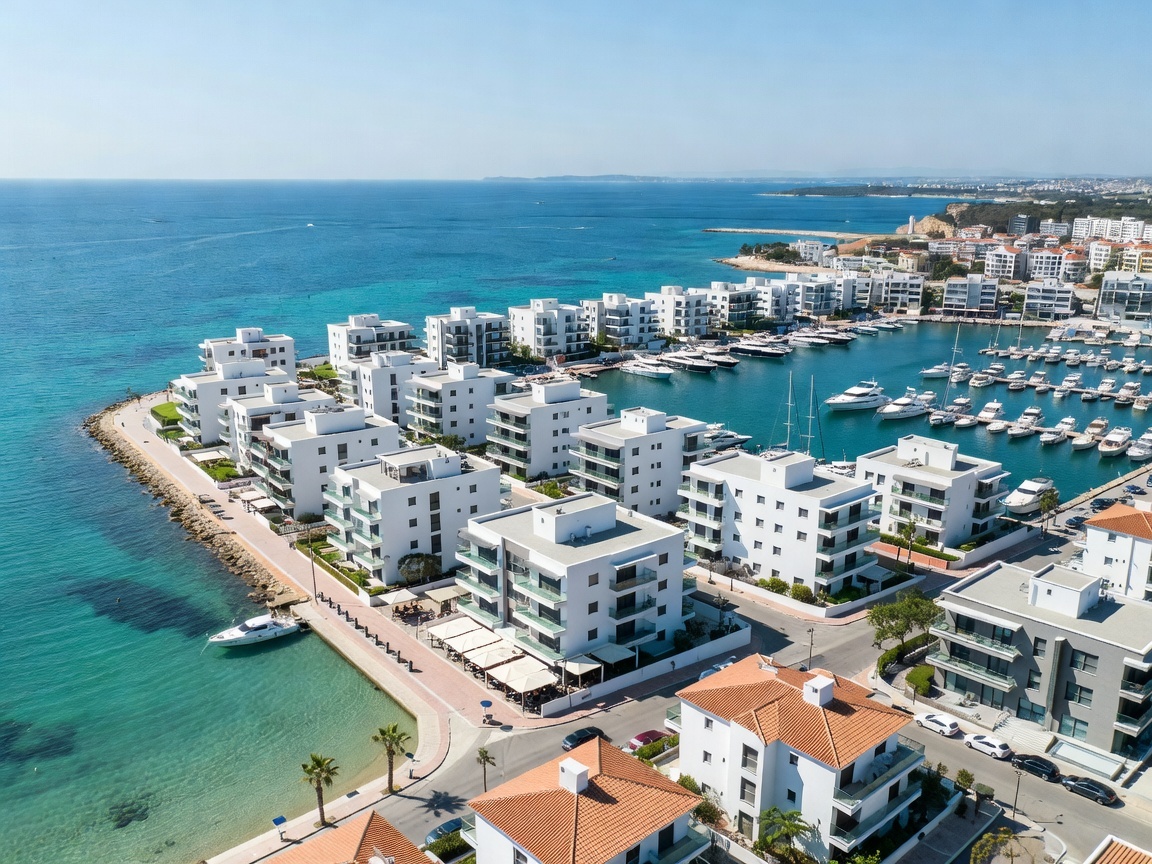
Step one: buy qualifying property. The Golden Visa requires an investment of at least €300,000 (plus VAT) in new residential property purchased directly from a developer. Resale homes don’t qualify for the residential route, though commercial property can be either new or resale. Many buyers start their search with villas for sale in Cyprus or new developments in premium districts.
Step two: secure permanent residence. Once your investment and income criteria are met, you obtain the Investor Immigration Permit—permanent residence for life. You can read the full requirements in our permanent residence through property investment guide.
Step three: live in Cyprus and build residence time. Permanent residence lets you settle on the island. As you accumulate lawful years of stay, you build toward the eight-year naturalisation threshold. Establishing tax residency during this period also matters—our Cyprus tax residency guide explains the 60-day and 183-day rules.
Step four: apply for naturalisation. After meeting the residence, language, and integration requirements, you apply for citizenship. Note that you must retain your qualifying investment while holding permanent residence, but once you become a citizen, you’re free to sell the property.
Before committing to any purchase on this path, it’s worth ordering an instant property report to verify the value and legal standing of the home you’re buying.
Documents, Costs, and How to Apply
Applications for naturalisation are submitted to the Civil Registry and Migration Department using the official application form (Form M127 for the standard route). Processing times vary but often take one to two years for standard naturalisation, and can be shorter under the skilled-professional route.
You’ll generally need to prepare the following:
- Valid passport and copies of all residence permits
- Proof of continuous, lawful residence for the qualifying period
- Greek language certificate (B1 or A2, depending on your route)
- Clean criminal record certificates from Cyprus and your home country
- Evidence of income, tax compliance, and financial stability
- Marriage or birth certificates where relevant (marriage and descent routes)
- Two references from Cypriot citizens confirming good character
Here’s a quick comparison of the main routes:
| Route | Residence required | Language | Best for |
|---|---|---|---|
| Standard naturalisation | 7 years + final 12 months | Greek B1 | Long-term residents and retirees |
| Skilled professional | 4 years (B1) or 5 years (A2) | Greek B1/A2 | Employees of foreign-interest companies |
| Marriage | ~3 years married | Good character | Spouses of Cypriot citizens |
| Descent | None (birthright) | Not applicable | People with Cypriot parents/grandparents |
Application and certificate fees apply at each stage, and most applicants use a licensed immigration lawyer to prepare the file correctly. Given the paperwork and multi-year timelines, professional guidance usually pays for itself in avoided delays.
Is the Cyprus Passport Worth Pursuing?
For anyone planning to make the island a long-term base, Cyprus citizenship is one of the most rewarding statuses in Europe. It delivers lifelong EU rights, a powerful passport, the freedom to keep your original nationality, and a legacy you can pass to your children.
The key takeaways for 2026 are simple. Citizenship by investment no longer exists, so plan for a residence-based route. Standard naturalisation takes eight years, while skilled professionals can qualify in four to five. Marriage and descent offer faster paths for those who qualify. And for most international buyers, the journey begins with a qualifying property purchase that unlocks permanent residence and, over time, a passport.
If you’re ready to take the first step, start by exploring verified listings across the island’s five districts—from Limassol to Paphos—on Cyprus’ largest property marketplace. The right home is the foundation of your path to citizenship, and getting that decision right is where confident planning begins.
This guide is for general information only and does not constitute legal advice. Immigration rules change, so confirm current requirements with the Civil Registry and Migration Department or a licensed Cyprus immigration lawyer before applying.
Keep reading

We analysed 249 Kouklia, Paphos listings: 210 houses, 20 plots and 6 apartments. Median 2-bed house asks EUR397,000. See prices, plots and…

We analysed 217 Erimi, Limassol listings: 105 apartments, 81 houses and 24 plots. Median 2-bed flat EUR295,000. See prices, the repeat-advert trap…

We analysed 319 Aglantzia, Nicosia listings: 155 apartments, 34 houses and 38 plots. Median 2-bed costs EUR257,500. See prices, rents and what…