What this guide covers
- How Does Public Transport in Cyprus Work?
- Bus Fares in Cyprus in 2026 (After the August Fare Rise)
- The Motion Card and App: How to Pay for Buses in Cyprus
- Getting Around the Cities: Urban Bus Networks
- Nicosia and Limassol
- Larnaca, Paphos and the Famagusta coast
- Intercity Buses: Travelling Between Cyprus Cities
- Airport Buses: Getting To and From Larnaca and Paphos
- Larnaca Airport
- Paphos Airport
- Public Transport vs a Car in Cyprus: Which Is Better?
- How Transport Links Shape Where to Live in Cyprus
- Frequently Asked Questions About Public Transport in Cyprus
- Does Cyprus have trains or a metro?
- How much does a bus ticket cost in Cyprus in 2026?
- What is the Motion card?
- Is there a bus from Larnaca airport to the city?
- The Bottom Line on Public Transport in Cyprus
If you’re moving to the island or just visiting, one question comes up fast: how does public transport in Cyprus actually work? The short answer is that Cyprus runs entirely on buses. There are no trains, no metro, and no trams anywhere on the island, so the bus network is the backbone of getting around without a car.
That network is more organised than many newcomers expect. A single smart-card system, the Motion card, now covers most of the country, buses reach every city and most villages, and dedicated services link the two international airports to the main towns. The trade-off is frequency: outside the cities, timetables thin out quickly, and Sundays can be sparse.
This guide breaks down everything you need to use public transport in Cyprus with confidence in 2026: who runs the buses, what a ticket costs after the August fare rise, how to pay with the Motion card, how to travel between cities, and how to get from Larnaca or Paphos airport into town. If you’re weighing up life on the island, our complete guide to living in Cyprus puts transport in the wider picture.
How Does Public Transport in Cyprus Work?
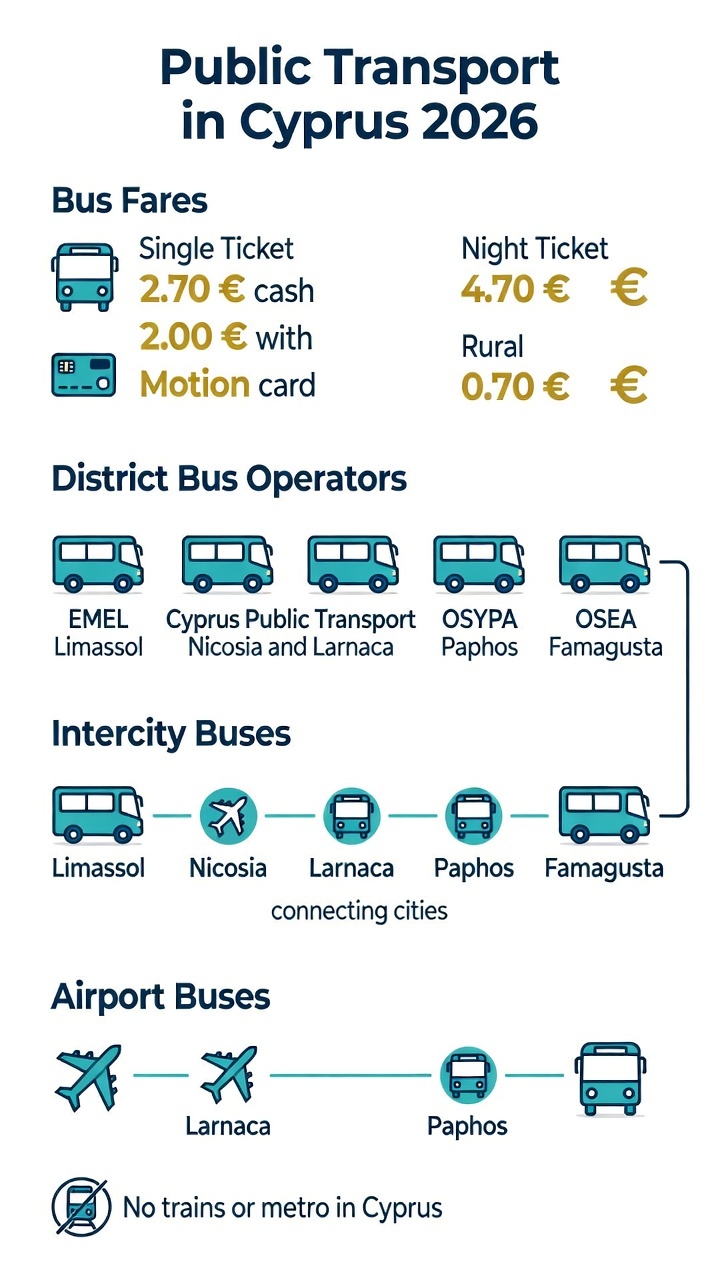
Public transport in Cyprus means buses, full stop. The Republic of Cyprus For everyday users the split rarely matters, because the Motion card and app work across most operators. What does matter is frequency. City buses in Limassol and Nicosia can run every 10–20 minutes at peak times, while rural and village routes may run only a handful of times a day. Always check the timetable before you rely on a return trip, especially on weekends. Bus fares in Cyprus rose on 3 August 2026, so any older figure you find online is now out of date. The increase was modest but applies across the board, and it’s the first thing to get right when budgeting for public transport in Cyprus. A standard daytime urban single now costs €2.70 in cash, up from €2.40. Pay with a Motion card instead and the same journey is €2.00, up from €1.80 — a clear reason to get a card if you’ll ride more than occasionally. Here’s the current picture. The official fare rise was confirmed by the Cyprus Mail ahead of its August launch. Prices can still differ slightly by district operator, so the Cyprus Public Transport website publishes the definitive fare table for each region. Children under six travel free, and rural fares remain the cheapest way to move between villages. If you plan to use buses daily, a season ticket is far better value than paying per trip. These belong on the Motion card, which we’ll cover next. The Motion smart card is the standard way to pay for public transport in Cyprus. It comes in two forms: a reloadable plastic card the size of a credit card, or a disposable paper card for a single or multi-journey trip. You tap it on the validator next to the driver every time you board — validation is mandatory on every leg of your journey. You can load a plastic Motion card two ways: with a cash balance for pay-as-you-go trips, or with a period pass. Season tickets are sold for 7, 30, or 365 days and cover unlimited travel on the operator’s routes. In Paphos, for example, a 30-day pass runs about €70. Top up at operator sales offices, kiosks, ticket vending machines, or through the official app. Discounts are generous for those who qualify. Students, pensioners, and teenagers with valid ID typically get around 50% off. Secondary-school students in Cyprus can load a monthly ticket for just €5, or an annual ticket for €30 — a rounding error compared with running a car. A personalised discount card costs about €5 to issue. If you’ve never topped up a card before, this short walkthrough shows the process from start to finish. Within each city, the local operator runs a web of urban routes connecting residential areas, the centre, beaches, and shopping districts. Coverage and frequency are best in the two largest urban markets. Nicosia, the capital, and Limassol, the coastal business hub, have the densest networks and the most frequent buses. Core routes can run every 10–20 minutes during the day, making car-free living realistic if you settle near a main line. Both cities are also the busiest property markets on the island — you can browse current listings in Nicosia and Limassol to see which neighbourhoods sit on strong bus corridors. Larnaca and Paphos have smaller but perfectly usable urban networks, with buses linking the seafront, town centre, and outer suburbs. In the Famagusta free area, OSEA connects the resort towns of Ayia Napa, Protaras, and Paralimni — handy in summer, quieter off-season. Everywhere outside the big two cities, plan around timetables rather than assuming a bus will turn up soon. To travel between towns, you use the InterCity Buses network rather than the local operators. These modern coaches link all the main cities on a regular daily schedule, and they’re remarkably cheap compared with the distances involved. Fares run from around €4 one way between neighbouring cities up to roughly €9 for the longest cross-island trips. Journey times are short because Cyprus is compact: Larnaca to Limassol takes about an hour, as does Limassol to Paphos, while the longer Larnaca-to-Paphos run is closer to 1 hour 45 minutes. You can usually pay the driver, and return or multi-day tickets are available. For anyone relocating without a car, the intercity network makes a car-free lifestyle workable for regular trips — commuting between cities, weekend travel, or airport runs. If you’re planning a move, our guide to moving to Cyprus from the UK covers the practicalities of settling in, and our cost of living in Cyprus breakdown shows how transport fits your monthly budget. Both of Cyprus’s international airports — Larnaca (LCA) and Paphos (PFO) — are served by buses, so you rarely need a taxi to reach town. This is one of the most searched aspects of public transport in Cyprus, and the good news is that services are frequent and affordable. From Larnaca Airport, urban routes such as the 425 and 429 run to Finikoudes beach and the central station in about 25 minutes, roughly every 20 minutes through the day. For onward travel, the private Kapnos Airport Shuttle connects the airport directly to Nicosia for around €16, and intercity coaches reach Limassol, Ayia Napa, and Paphos. The bus stops sit a short walk from the terminal, on the left as you exit the arrivals level. From Paphos Airport, route 612 runs to the town centre in about 30 minutes at the standard urban fare, giving budget travellers an easy link into Kato Paphos and the harbour. Intercity connections onward to Limassol and beyond are straightforward, and the whole west of the island is within easy reach. The one gap worth noting: late-night arrivals may find bus services have finished, so check the last departure before you land or plan for a taxi. Here’s the honest trade-off. Buses are cheap, cover the cities and airports well, and remove the cost and hassle of owning a vehicle. For students, budget-conscious residents, and anyone living centrally in Nicosia or Limassol, public transport in Cyprus can genuinely meet daily needs. But most residents still drive, and for good reason. Cyprus is car-oriented: village routes are infrequent, evening and Sunday services are limited, and reaching beaches, hiking trails, or the Troodos mountains by bus is difficult. If you live outside a city centre or value spontaneity, a car quickly becomes the practical default. If you go that route, read our guide to getting a driving licence in Cyprus before you get behind the wheel. A common approach is a hybrid one: rely on buses and intercity coaches for commuting and airport trips, and rent or own a car for weekends and exploring. Retirees, in particular, often find the bus network covers most of their routine needs — our guide to retiring in Cyprus looks at how transport shapes day-to-day life. For property buyers and renters, bus access is a quiet but real factor in choosing a neighbourhood. A home on a frequent urban route in Limassol or Nicosia offers genuine car-free convenience, while a village property may be beautiful yet effectively require a vehicle. If you can live without a car, prioritise central districts near main bus corridors, close to intercity stops, or within reach of an airport route. Our guide to the best places to live in Cyprus compares districts across lifestyle and practicality, so you can weigh transport alongside price, amenities, and community. Before committing to any property, an instant property report helps you assess the fundamentals with confidence. No. Cyprus has no railway, metro, or tram network — the last train line closed in 1951. Public transport in Cyprus is provided entirely by buses, run by district operators and linked between cities by the InterCity Buses network. After the 3 August 2026 fare rise, a daytime urban single costs €2.70 in cash or €2.00 with a Motion card. Night journeys from 9pm cost €4.70 cash, and rural routes are €0.70. Season passes for 7, 30, or 365 days offer far better value for regular riders. Motion is Cyprus’s shared bus smart-card system. You load it with cash balance or a period pass, then tap it on the validator each time you board. It’s available as a reloadable plastic card or a disposable paper card, and it works across most district operators. Yes. Urban routes 425 and 429 run from Larnaca Airport to Finikoudes and the central station in about 25 minutes, roughly every 20 minutes. The private Kapnos Airport Shuttle also links the airport to Nicosia, and intercity coaches serve Limassol, Paphos, and Ayia Napa. Public transport in Cyprus is straightforward once you know the basics: it’s an all-bus system, organised by district, unified by the Motion card, and reasonably priced even after the August 2026 fare rise. In the cities and to the airports, it works well; in the villages and on weekends, frequency is the catch. For newcomers, the smart move is to test the network where you plan to live before deciding whether you need a car. Get a Motion card, download the Cyprus Bus app to track services in real time, and try your likely routes at the times you’d actually travel. Combine that with our living in Cyprus guide and you’ll have a clear picture of how car-free — or car-light — your Cyprus life can be. Fares and timetables change; the figures here reflect the position as of August 2026. Always confirm current prices and schedules with your district operator before travelling.District Bus operator Covers Limassol EMEL Urban and suburban Limassol routes Nicosia Cyprus Public Transport (CPT) The capital and surrounding villages Larnaca Cyprus Public Transport (CPT) Larnaca town, airport and region Paphos Pafos Buses (OSYPA) Paphos, Coral Bay and the west Famagusta area OSEA Ayia Napa, Protaras, Paralimni Between cities InterCity Buses Cross-island coach links Bus Fares in Cyprus in 2026 (After the August Fare Rise)
Ticket type Cash fare Motion card fare Daytime urban single €2.70 €2.00 Night single (from 9pm) €4.70 €3.50 Rural / village route €0.70 €0.70 The Motion Card and App: How to Pay for Buses in Cyprus
Getting Around the Cities: Urban Bus Networks
Nicosia and Limassol
Larnaca, Paphos and the Famagusta coast
Intercity Buses: Travelling Between Cyprus Cities
Airport Buses: Getting To and From Larnaca and Paphos
Larnaca Airport
Paphos Airport
Public Transport vs a Car in Cyprus: Which Is Better?
How Transport Links Shape Where to Live in Cyprus
Frequently Asked Questions About Public Transport in Cyprus
Does Cyprus have trains or a metro?
How much does a bus ticket cost in Cyprus in 2026?
What is the Motion card?
Is there a bus from Larnaca airport to the city?
The Bottom Line on Public Transport in Cyprus
Keep reading

Larnaca Property Market Surges: Which Areas Are Leading the Price Rise? Larnaca’s property market has experienced a notable surge in prices recently,…

We analysed 66 Tseri, Nicosia listings: 18 apartments, 8 houses and 34 plots. Median 2-bed price is EUR174,000. See prices and what…

We analysed 246 Lakatamia, Nicosia listings: 129 apartments, 52 houses and 46 plots. Median 2-bed price is EUR195,000. See prices and what…