What this guide covers
- How Hospitals in Cyprus Work: The Public and Private Split
- The Eight State Hospitals in Cyprus
- Private Hospitals in Cyprus by District
- Nicosia
- Limassol
- Larnaca and Paphos
- Famagusta
- What GESY Covers at a Hospital — and What You Pay
- Emergencies: A&E Departments, 112 and Ambulances
- Hospital Access and Where You Buy Property
- Frequently Asked Questions About Hospitals in Cyprus
- How many hospitals are there in Cyprus?
- Are hospitals in Cyprus free?
- Can I use a private hospital with GESY?
- Do doctors in Cyprus speak English?
- Which hospital should I go to in an emergency?
- What do I need to register with GESY?
- The Bottom Line on Hospitals in Cyprus
Cyprus runs one of the more generous healthcare systems in Europe, and most people who move here are surprised by how little they end up paying. But the map of hospitals in Cyprus is not obvious from the outside. There are eight state hospitals, roughly seventy-five private and public facilities contracted to provide inpatient care, and a national health system — GESY — that quietly determines which door you are supposed to walk through and what happens to your bill when you do.
This guide maps every state hospital in Cyprus, explains how the private sector fits alongside it, sets out exactly what GESY charges in 2026, and covers the part most healthcare guides skip: how hospital access should influence where you buy or rent. Because in a country where two districts hold two-thirds of the hospital capacity, proximity to care is a genuine property variable — not an afterthought.
One note before we start. This is general information, not medical or insurance advice. Co-payment amounts and hospital services change; confirm anything that affects a decision directly with the Health Insurance Organisation or the hospital concerned.
How Hospitals in Cyprus Work: The Public and Private Split
Cyprus has a two-tier hospital system, and since GESY launched the line between the tiers has blurred considerably.
The public tier is run by the State Health Services Organisation — SHSO, known locally by its Greek acronym OKYPY. It operates the eight state hospitals, including every 24-hour Accident and Emergency department on the island. These are the facilities that handle trauma, complex emergencies and the bulk of unplanned admissions.
The private tier is large for a country of this size: private hospitals, polyclinics and specialist centres that historically served anyone who could pay or held private insurance. What changed with GESY is that most of them are now contracted to the system. According to Health Insurance Organisation data, 75 facilities across Cyprus provide inpatient care under GESY, and a beneficiary can choose any of them.
That is the single most useful thing to understand about hospitals in Cyprus. If you are registered with GESY, a private hospital is often not a private bill — it is simply another hospital you are entitled to use, provided you arrive with a referral. Our complete guide to healthcare in Cyprus covers how the GESY system itself works, including registration and eligibility.
- Referral routes into inpatient care: your personal doctor (GP), a specialist, an A&E department, or a transfer from another hospital
- What inpatient cover includes: surgery, internal medicine, radiology, obstetrics and gynaecology, diagnostic laboratories and intensive care
- The threshold: care requiring at least one overnight stay, or equipment only available in a hospital setting
The Eight State Hospitals in Cyprus
Every state hospital in Cyprus sits under SHSO. Seven of the eight run a 24/7 Accident and Emergency department; Archbishop Makarios III is the specialist mother-and-child hospital and works differently.
| Hospital | District / Location | Switchboard | 24/7 A&E |
|---|---|---|---|
| Nicosia General Hospital | Strovolos, Nicosia | +357 22603000 | Yes — 22604011 |
| Archbishop Makarios III Hospital | Strovolos, Nicosia | +357 22405000 | Mother & child |
| Limassol General Hospital | Kato Polemidia, Limassol | +357 25801100 | Yes — 25801207 |
| Larnaca General Hospital | Larnaca | +357 24800500 | Yes — 24800370 |
| Paphos General Hospital | Anavargos, Paphos | +357 26803100 | Yes — 26803266 |
| Famagusta General Hospital | Paralimni, Famagusta | +357 23200000 | Yes — 23200213 |
| Troodos Hospital | Troodos mountains | +357 25806700 | Yes — 25806700 |
| Polis Chrysochous Hospital | Polis, Paphos district | — | Yes — 26821817 |
Two of these deserve a closer look. Nicosia General Hospital in Strovolos is the largest hospital in Cyprus and the reference centre for the most complex cases; it opened in its current form in 2006. Archbishop Makarios III Hospital, also in Strovolos, opened in 1984 as a dedicated mother-and-child facility and is currently in the middle of a major expansion, with a new building on the southern side of the complex due for completion in September 2026.
The other district hospitals — Limassol General in Kato Polemidia, Larnaca General, and Paphos General in Anavargos — each anchor their district’s emergency and inpatient capacity. Troodos and Polis Chrysochous are the two rural hospitals, and they matter more than their size suggests: they are the reason a mountain village or the far northwest of Paphos district is not a two-hour drive from any emergency care at all.
Private Hospitals in Cyprus by District
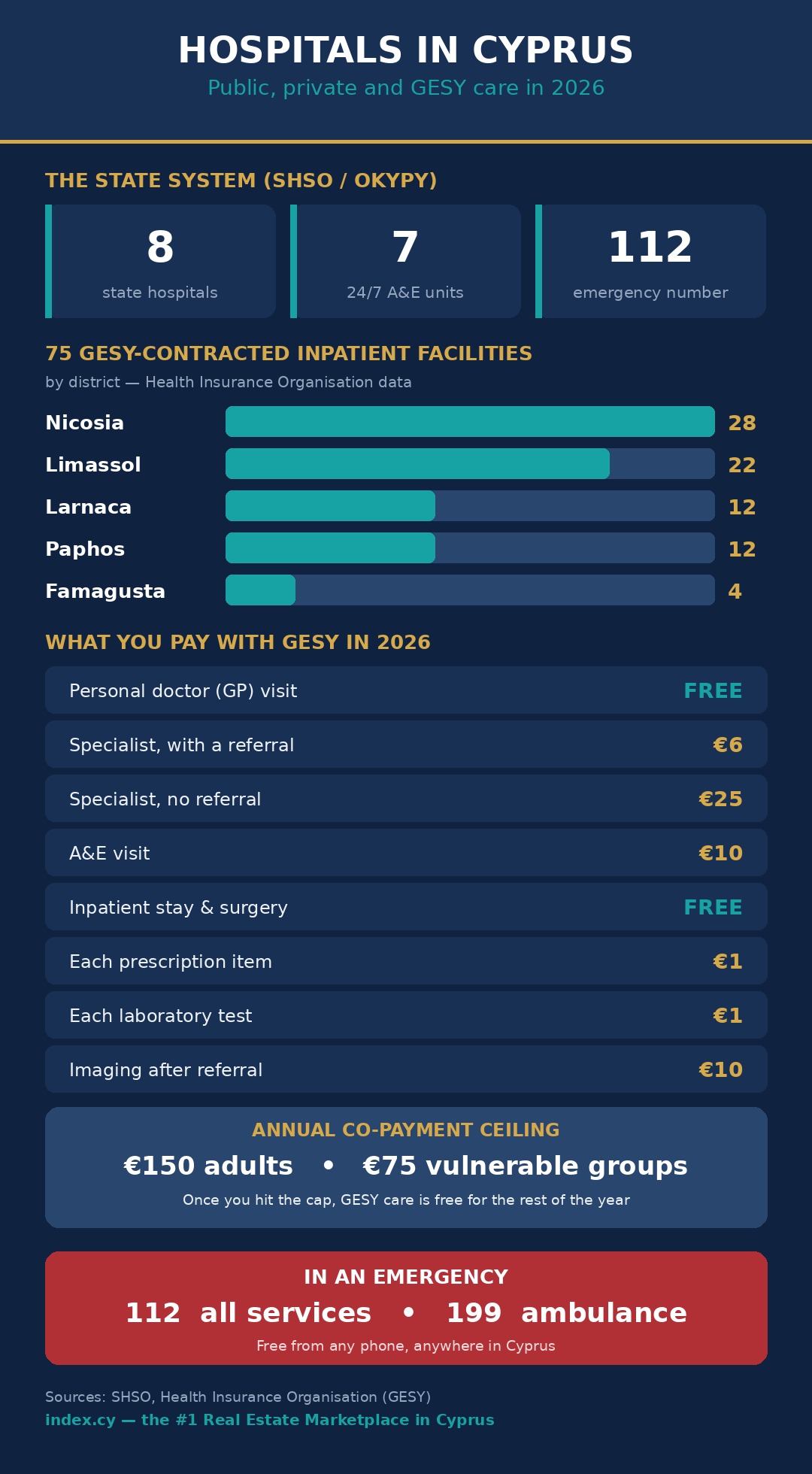
Private hospital capacity in Cyprus is heavily concentrated. Of the 75 facilities providing inpatient care under GESY, Nicosia holds 28 and Limassol 22. Larnaca and Paphos have 12 each. Famagusta district has four.
That distribution is not a quirk — it tracks population and wealth, and it has direct consequences for anyone choosing between districts.
Nicosia
The capital has the deepest specialist bench on the island. Alongside Nicosia General you will find Aretaeio Hospital, Apollonion Private Hospital, Hippocrateon Hospital, the American Medical Center, and the Mediterranean Hospital of Cyprus. Nicosia is also home to two national reference centres: the Bank of Cyprus Oncology Centre and the Cyprus Institute of Neurology and Genetics. For rare conditions or genetic medicine, this is where the expertise sits.
Limassol
Limassol’s private sector is the fastest-growing, mirroring the city’s economy. Ygia Polyclinic — founded in 1983 and the oldest and largest private hospital in Cyprus, with 188 beds and eight operating theatres — joined GESY in September 2023 and was subsequently acquired by ECM Partners, with the Athens Medical Group brought in to manage it. The German Oncology Center, Limassol Clinic, Apostles Peter and Paul Private Hospital and Opalia Clinic round out a genuinely competitive market.
Larnaca and Paphos
Larnaca is served by St. Raphael Private Hospital, Holy Cross Hospital and Faneromeni New Polyclinic, among others. Paphos — with a large and long-established international community — has a notably expat-oriented private sector: Royal Artemis Private Hospital, Evangelismos Private Hospital, Iasis Hospital and St. George & Blue Cross. English is spoken as a matter of course in most of them.
Famagusta
The Famagusta district is the thin spot. Four inpatient facilities in total: Famagusta General in Paralimni, plus Santa Marina Polyclinic, Lito Private Hospital and Napa Olympic Medical Centre. For anything complex, residents of Ayia Napa and Protaras travel to Larnaca or Nicosia. If you are buying in the far east of the island, build that drive into your thinking.
What GESY Covers at a Hospital — and What You Pay
This is where Cyprus surprises people. Under GESY in 2026, an inpatient stay — including the surgery, the intensive care and the nursing — carries no co-payment at all. What you pay for are the steps around it.
| Service | Your co-payment in 2026 |
|---|---|
| Personal doctor (GP) visit | Free |
| Specialist visit, with a referral | €6 |
| Specialist visit, without a referral | €25 |
| Accident & Emergency visit | €10 |
| Inpatient stay, surgery, ICU | Free |
| Each prescription item | €1 (capped at €15 per prescription) |
| Each laboratory test | €1 |
| Diagnostic imaging after referral | €10 |
There is also an annual ceiling. Once your co-payments reach €150 in a calendar year, every further GESY service is free for the rest of that year. For vulnerable groups — recipients of the Guaranteed Minimum Income, low-income pensioners, and children up to 21 — the ceiling is €75.
The €6 versus €25 gap in that table is the one to internalise. Going through your personal doctor rather than walking into a specialist’s office directly costs you nineteen euros every time. Register a GP early; it is the single highest-return administrative task after arrival.
GESY is funded through payroll contributions rather than a separate premium, which is why the co-payments are so low. Our guide to social insurance in Cyprus sets out the contribution rates, and the cost of living in Cyprus guide places healthcare spending next to housing, utilities and everything else.
Emergencies: A&E Departments, 112 and Ambulances
In an emergency anywhere in Cyprus, dial 112. It reaches police, fire and ambulance, it is free from any phone including a mobile with no credit, and operators handle calls in English. For an ambulance specifically you can also dial 199.
The seven SHSO A&E departments run 24 hours a day, 365 days a year, and they use a five-tier triage system based on the Emergency Severity Index. Tiers 1 and 2 go straight through to treatment. Tiers 3 and 4 are told plainly that their condition is not life-threatening and that there will be a wait. Tier 5 cases are non-emergencies and are encouraged to see their personal doctor instead — if they stay, they are seen after everyone else.
Understanding that triage system explains most complaints you will read online about A&E waiting times in Cyprus. The queue is not first-come-first-served, and it is not meant to be.
- Bring: your ID, passport or ARC (Alien Registration Number), and your GESY details if registered
- Expect: triage first, then registration, then examination in triage order
- Not registered with GESY yet? You will still be treated in an emergency, but expect to pay and reclaim through travel or private insurance
If you have just arrived and have not yet completed residency formalities, our guides to the Cyprus yellow slip and relocating to Cyprus cover the paperwork that unlocks GESY registration.
A useful walkthrough of how the Cyprus healthcare system fits together. Note that it was recorded before the current co-payment schedule took effect — use the 2026 figures in the table above rather than any amounts quoted in the video.
Hospital Access and Where You Buy Property
Estate agents talk about sea views and school catchments. Almost nobody raises hospital access — and for retirees and families it is often the variable that ages best.
The practical question is not “is there a hospital nearby?” but “how long is the drive to a 24-hour A&E, and how deep is the specialist capacity in this district?” Those two answers vary enormously across Cyprus.
| District | 24/7 A&E | Inpatient facilities | What it means in practice |
|---|---|---|---|
| Nicosia | Nicosia General | 28 | Deepest specialist care; national reference centres |
| Limassol | Limassol General, Troodos | 22 | Strong and growing private sector |
| Larnaca | Larnaca General | 12 | Solid district cover; Nicosia within ~45 min |
| Paphos | Paphos General, Polis | 12 | Expat-oriented private sector; two A&E points |
| Famagusta | Famagusta General | 4 | Thinnest cover; complex cases travel |
A few patterns are worth naming. In Limassol, the general hospital sits in Kato Polemidia, inland and to the northwest — so the western suburbs are closer to emergency care than the tourist strip east of the centre, which reverses the usual price gradient. In Paphos, Polis Chrysochous Hospital is what makes the northwest of the district viable for older buyers; without it, Latchi and the Akamas villages would be a long way from anything. And in Famagusta, buyers in Ayia Napa and Protaras should be honest with themselves about a drive to Larnaca or Nicosia for anything serious.
If you are weighing districts, our guide to the best places to live in Cyprus compares them across every liveability factor, and the retiring in Cyprus guide looks specifically at what changes when healthcare moves up your priority list. You can browse current listings in Nicosia, Limassol, Larnaca and Paphos, or run an instant property report on any address to see how it is priced against comparable homes.
One practical tip: check the drive time at the hour you would actually need it. Nicosia’s ring road at 8am and the Limassol coastal road in August are not the same roads they are on a quiet Sunday. Our public transport guide is worth a look too if you are considering a home without a car.
Frequently Asked Questions About Hospitals in Cyprus
How many hospitals are there in Cyprus?
There are eight state hospitals run by the State Health Services Organisation, and 75 facilities in total — public and private — contracted with the Health Insurance Organisation to provide inpatient care under GESY. Nicosia has 28 of them, Limassol 22, Larnaca and Paphos 12 each, and Famagusta district 4.
Are hospitals in Cyprus free?
For anyone registered with GESY, inpatient care — including surgery and intensive care — carries no co-payment. You pay small co-payments for specialist visits (€6 with a referral), A&E visits (€10), prescriptions and tests, capped at €150 a year for most adults.
Can I use a private hospital with GESY?
Yes. Most private hospitals in Cyprus are contracted with GESY, and beneficiaries can choose any contracted hospital for inpatient care provided they have a referral from a personal doctor, a specialist, an A&E department or another hospital.
Do doctors in Cyprus speak English?
Widely, yes. English is common across both the public and private systems, and near-universal in Paphos and Limassol private hospitals, which serve large international communities. Medical training in Cyprus is frequently completed in the UK, Greece or elsewhere in Europe.
Which hospital should I go to in an emergency?
Dial 112 and let the ambulance service decide — they route to the appropriate A&E. If you are driving yourself, go to the nearest of the seven SHSO Accident and Emergency departments. Private hospitals do not universally run 24-hour emergency departments.
What do I need to register with GESY?
Legal residency in Cyprus and a personal identification document — an ID card or an ARC for non-Cypriots. Registration is done through the GESY portal and you then select a personal doctor. See our healthcare in Cyprus guide for the full process.
The Bottom Line on Hospitals in Cyprus
The hospitals in Cyprus are better than the island’s size would suggest, and considerably cheaper to use than most new arrivals expect. Eight state hospitals cover every district, seven of them with round-the-clock emergency departments, and 75 contracted facilities mean a GESY beneficiary can walk into a private hospital and be treated as a public patient.
- Register with GESY and pick a personal doctor early — it turns a €25 specialist visit into a €6 one
- Inpatient care is free under GESY, including surgery and ICU; co-payments apply to the steps around it and stop at €150 a year
- 112 works everywhere, free, in English, for every emergency service
- Capacity is concentrated — Nicosia and Limassol hold two-thirds of the island’s inpatient facilities
- Check the drive time to A&E before you buy, at the hour you would really need it
You can browse every hospital we have mapped on our hospitals in Cyprus directory, and see how any property you are considering sits relative to them. For the full picture on how care is funded and who qualifies, start with the healthcare in Cyprus guide.
Official sources worth bookmarking: the blank” rel=”noopener”>State Health Services Organisation A&E pages for hospital contacts and triage guidance, the blank” rel=”noopener”>GESY portal for registration and co-payment schedules, and this district-by-district breakdown of all 75 contracted facilities compiled from Health Insurance Organisation data.
Keep reading

Larnaca Property Market Surges: Which Areas Are Leading the Price Rise? Larnaca’s property market has experienced a notable surge in prices recently,…
We analysed 66 Tseri, Nicosia listings: 18 apartments, 8 houses and 34 plots. Median 2-bed price is EUR174,000. See prices and what…
We analysed 246 Lakatamia, Nicosia listings: 129 apartments, 52 houses and 46 plots. Median 2-bed price is EUR195,000. See prices and what…