
If you earn money in Cyprus, sooner or later you will meet TAXISnet — the Tax Department’s online filing portal, and the only route through which personal income tax returns are accepted. It is also the source of more confusion than almost any other piece of Cyprus admin, because the government spent two years telling everyone it was being replaced.
Here is the short version, current as of August 2026: it has not been replaced. Your 2025 personal income tax return goes through TAXISnet, the filing window opened on 19 June 2026, and the deadline to file and pay is 31 October 2026. The new Tax For All platform is live for registration, VAT and employer functions, but the full switch for personal returns has been pushed to 2027.
This guide covers what TAXISnet actually does, how to register and get a Tax Identification Code, what changes when Tax For All takes over, and — because most of our readers own or rent property here — exactly what the 2026 tax reform changed for landlords and sellers.
This is general information, not tax or legal advice. Cyprus tax rules changed substantially on 1 January 2026 and continue to be phased in. Confirm your own position with a licensed accountant or the Tax Department before you file.
TAXISnet is the Cyprus Tax Department’s electronic filing system, hosted at taxisnet.mof.gov.cy. It is where individuals submit the personal income tax return (the TD1, still widely called the IR1), where employers file the return of emoluments, and where companies have historically filed the corporate return.
Yes — it is still the portal for personal returns. That deserves emphasis, because a great deal of the advice circulating online says otherwise.
In April 2026 the Tax Department decided that employees and self-employed individuals without audited accounts would keep using TAXISnet for the current filing cycle, reversing the expectation that Tax For All would take over. Speaking to the Cyprus Mail, the department described the move as a deliberate, temporary and strategic decision: “It is wiser to use TAXISnet for one year more before the reform comes into effect, and then we will roll out Tax For All fully.”
The reasoning was practical. Cyprus introduced a wide-ranging tax reform in January 2026, and asking accountants and employers to absorb a new set of rules and a new platform in the same year was judged too disruptive. So the reform applies from the 2026 tax year, filed in 2027 — which is also when Tax For All is expected to handle personal returns for the first time.
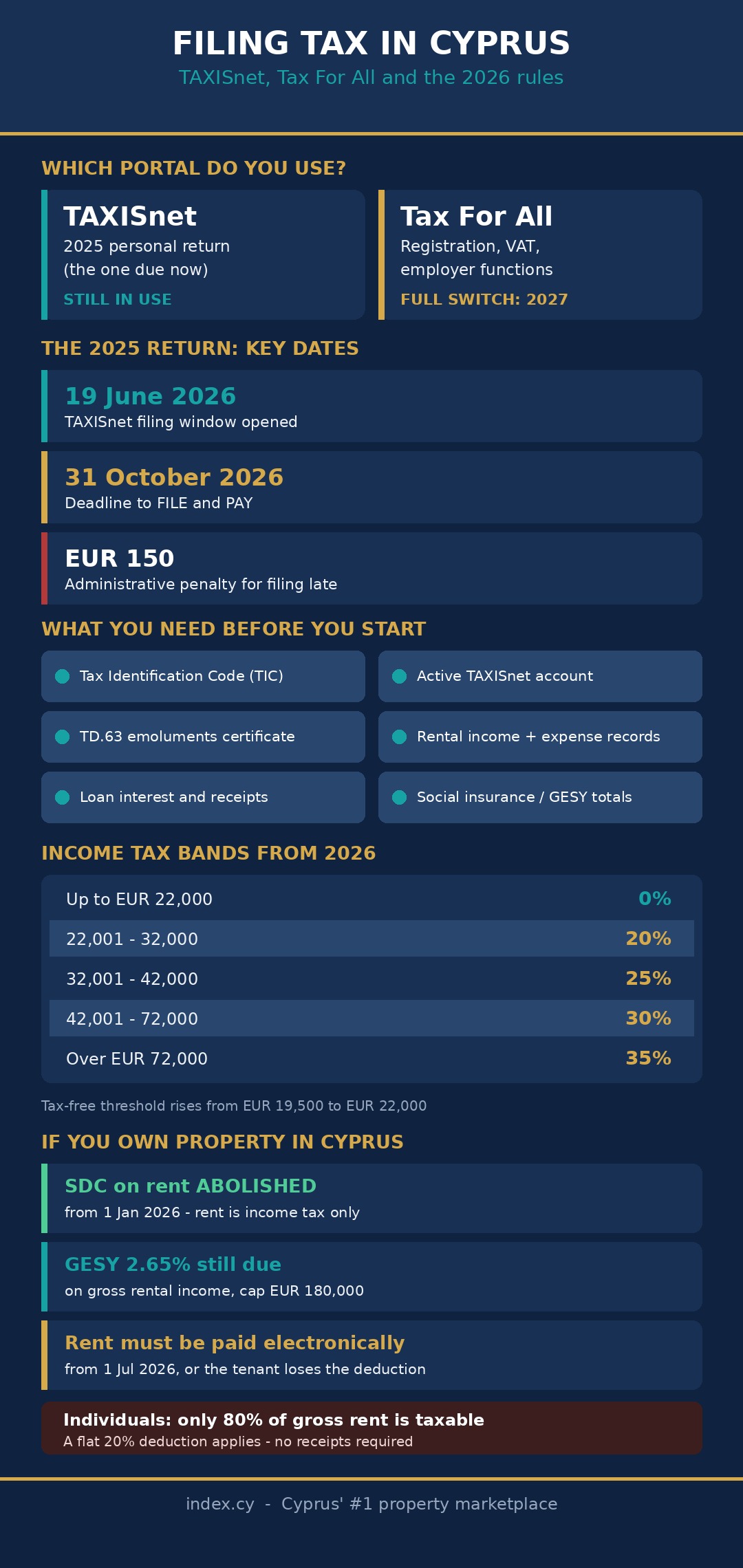
Both systems are live right now, and they do different things. Confusing them is the single most common reason people waste an afternoon on the wrong website.
| Function | Where it happens in 2026 |
|---|---|
| Personal income tax return (TD1) for 2025 | TAXISnet |
| Employer return of emoluments | TAXISnet |
| New taxpayer registration / Tax Identification Code | Tax For All |
| VAT registration and VAT returns | Tax For All |
| Certain employer and PAYE functions | Tax For All |
| Personal income tax return for 2026 onwards | Tax For All (expected, from 2027) |
Tax For All is designed as a single platform unifying registration, filing and payment, accessed through the government’s CY Login identity service rather than a separate TAXISnet username. Access via CY Login went live in 2025, and more than 12,000 accountants, employers and other stakeholders have since been through training on the system.
The rollout has slipped repeatedly — the Tax Department has acknowledged software integration problems, new forms, calculation tools and cross-departmental data feeds all needing to land before personal returns can move across. Parts of the system reverted to older infrastructure during 2025.
The practical takeaway: register with Tax For All if you are new to the Cyprus tax system, but do your 2025 filing on TAXISnet. Everyone moves eventually. Not this year.
You cannot file anything without a Tax Identification Code (TIC) — sometimes written TIN, and the number Cyprus banks, employers and the Land Registry will all ask you for. New registrations now go through Tax For All rather than the old paper route.
The sequence for an individual:
The Tax Department publishes step-by-step online registration guides for each taxpayer category on gov.cy, and they are worth opening before you start rather than halfway through.
If you are relocating, the order matters. Sort your residency document first — our guides to the Cyprus yellow slip and the pink slip cover the applications in detail — because you cannot complete the tax registration without one. A Cyprus bank account is worth arranging in parallel, since tax refunds and payments both run through it.
Separately, once your TIC is issued you will need a TAXISnet account to actually file. That registration is its own step, done on the TAXISnet site with your TIC and identity details, and the credentials arrive by post — so start it well before a deadline, not the week of one.
The Tax Department opened the 2025 filing window on 19 June 2026 and set the deadline at 31 October 2026 — an extension from the statutory 31 July date, granted because the window opened so late in the year.
Two points people routinely miss. First, 31 October is the deadline for payment as well as filing: if the return produces a balance owing, it must be settled by that date. Second, filing is electronic only. There is no paper alternative.
| Date | What happens |
|---|---|
| 19 June 2026 | TAXISnet opened for 2025 personal returns |
| 31 October 2026 | Deadline to file the TD1 and pay any balance |
| After 31 October 2026 | €150 administrative penalty, plus charges and interest on unpaid tax |
Who has to file for 2025? Cyprus tax residents with gross income above €19,500 — the threshold that applied in 2025, before the reform raised it. “Gross income” means total income before deductions, and it includes far more than salary: business profits, rental income, pensions, dividends, interest and royalties all count.
Have your paperwork ready before you log in. That means your TD.63 emoluments certificate from your employer, records of any rental income and the expenses you are claiming against it, mortgage interest statements, social insurance and GESY totals, and receipts for anything deductible. Our social insurance guide explains which contributions reduce your taxable income, and the working in Cyprus guide covers how payroll deductions appear on a Cypriot payslip.
File early. The portal is reliably slow in the final fortnight, and a rejected submission on 30 October leaves you no room to fix it.

This is where TAXISnet stops being generic admin and starts costing or saving you real money. If you own property in Cyprus, three things changed on 1 January 2026 and one more on 1 July.
Until the end of 2025, rent was hit twice: Special Defence Contribution at 3% on gross rent (reduced to an effective 2.25%) and income tax on the net figure. SDC on rental income has been abolished. Rent is now taxed under income tax alone — progressive rates for individuals, 15% corporation tax for companies.
For an individual landlord with €24,000 of annual rent, that is roughly €540 a year back in your pocket. Across a small portfolio it adds up quickly. Corporate landlords see less benefit: the SDC saving of 2.25% is offset by the corporation tax rate rising from 12.5% to 15%, leaving them marginally worse off overall.
Individuals get an automatic 20% deduction for deemed expenses, with no receipts required. On €24,000 of gross rent, €4,800 comes straight off and €19,200 goes into the income tax computation. Mortgage interest on the rented property is deductible on top of that. Our rental income tax guide works through the arithmetic in full.
GESY has not gone away. The 2.65% health system contribution still applies to gross rental income, capped at €180,000 of income a year.
From 1 July 2026, rent on Cyprus immovable property paid in cash is no longer tax-deductible for the tenant. Bank transfer, card and e-payment all qualify; cash does not.
The penalty technically falls on the tenant, but landlords should care anyway. Tenants will insist on electronic payment to protect their deduction, electronic payments create an audit trail that can be cross-checked against your return, and a cash-only listing is going to look increasingly unattractive. If you are still collecting rent in cash, update the tenancy agreement and hand over your bank details.
Thinking about buying to rent out? The buy-to-let guide covers yields by district, and if you are letting short-term the rules differ again — see the Airbnb and short-term rental guide. Browse current apartments for sale across Cyprus or run an instant property report on anything you are weighing up.
A concise walk-through of the 2026 Cyprus tax reform. Note that the reform applies to the 2026 tax year, filed in 2027 — the return you are filing on TAXISnet right now is for 2025, under the old rules.
The return you file in 2027 will look different. These are the changes that matter most.
The tax-free threshold rises from €19,500 to €22,000, and every band above it moves up, so the 35% top rate only bites above €72,000.
| Taxable income | Rate (from 2026) |
|---|---|
| Up to €22,000 | 0% |
| €22,001 – €32,000 | 20% |
| €32,001 – €42,000 | 25% |
| €42,001 – €72,000 | 30% |
| Over €72,000 | 35% |
Current rates, allowances and exemptions are set out in PwC’s Cyprus tax summaries, which are updated as legislation changes.
Almost everyone will have to file. From the 2026 tax year, all Cyprus tax residents aged 25 to 70 must submit an annual return regardless of income level — including those earning below the threshold and owing nothing. This is a significant expansion; if you have never filed because your income was too low, that changes.
Reporting widens. Employment income, pensions, rents, dividends, interest, self-employment income and cryptocurrency gains all come into scope, and a new T.F.59 form will handle deductions for housing, family status, energy upgrades and insurance through employer withholding systems.
Stamp duty is gone. The Stamp Duty Law was abolished for contracts executed on or after 1 January 2026 — worth about €998 on a €500,000 purchase contract. Our stamp duty guide explains what still applies to pre-2026 contracts, and the property transfer fees guide covers the Land Registry charges that remain.
Capital gains exemptions jumped. The lifetime primary-residence exemption rose from €85,430 to €150,000, the general exemption from €17,086 to €30,000, and agricultural land from €25,629 to €50,000. If you used part of an old exemption, you can top up to the new limit. Anyone selling property in Cyprus should read the capital gains tax guide before agreeing a price.
Whether you pay Cyprus tax on any of this depends on residency and domicile status. Start with our tax residency guide and the non-dom guide — non-dom status still exempts you from SDC on dividends and interest, which for many investors is the whole point of being here.
A short list of the things that go wrong most often.
If your affairs run beyond a single employer — rental properties, foreign income, self-employment, a company — engage an accountant rather than working it out yourself. The fee is generally smaller than a single avoidable penalty.
Yes. The Tax Department confirmed in April 2026 that personal income tax returns for the 2025 tax year are filed through TAXISnet, not Tax For All. The full migration to Tax For All has been deferred to 2027, when 2026 returns are filed under the new reform rules.
31 October 2026. The filing window opened on 19 June 2026, and the same date is the deadline for paying any tax due. Late submission carries a €150 administrative penalty, with further charges and interest on unpaid balances.
Register through the Tax For All portal using a CY Login account. You will need an ID copy (Cypriot citizens), a yellow slip (EU residents), a pink slip (non-EU residents) or a home-country tax certificate (non-residents). Issue typically takes one to two weeks after submission.
If your gross income for 2025 exceeded €19,500, yes — rental income counts towards that threshold in full, before the 20% deemed-expense deduction. From the 2026 tax year the obligation widens further: all Cyprus tax residents aged 25 to 70 must file annually regardless of income.
No. Special Defence Contribution on rental income was abolished from 1 January 2026. Rent is now taxed under income tax only for individuals, or corporation tax at 15% for companies. The 2.65% GESY contribution on gross rent still applies.
The rent stops being tax-deductible for the tenant. The landlord is not directly penalised, but tenants have a clear financial reason to insist on bank transfer or card payment, and electronic records are what the Tax Department will cross-check against your declared rental income.
No. Personal income tax returns are accepted electronically only, through TAXISnet. You need a Tax Identification Code and an active TAXISnet account before you can submit anything.
TAXISnet is still the portal that matters for your personal return, whatever the noise about Tax For All suggests. File the 2025 return there, by 31 October 2026, and pay any balance on the same day. Register for a Tax Identification Code through Tax For All if you do not have one yet, and start that process weeks rather than days before you need it.
For property owners, 2026 is genuinely good news. SDC on rent is gone, the tax-free threshold is rising to €22,000, capital gains exemptions have nearly doubled and stamp duty has disappeared entirely. The trade-off is more reporting: from next year almost every resident aged 25 to 70 files a return, and rent has to move electronically.
None of that is difficult once you know which portal to use and what the deadline actually is — which is the part most guides get wrong.
Planning your next move in the Cyprus property market? Browse verified listings across Limassol and every district, compare houses for sale, or run an instant property report before you commit. If you are still weighing up the island, relocating to Cyprus and the Cyprus property tax guide are the right places to start.
Sources: Cyprus Tax Department announcements as reported by the Cyprus Mail (May 2026), the official Tax For All portal on gov.cy, and PwC’s Cyprus tax summaries. Rules and deadlines change — verify current dates with the Tax Department or a licensed accountant before filing. This guide does not constitute tax, legal or financial advice.