
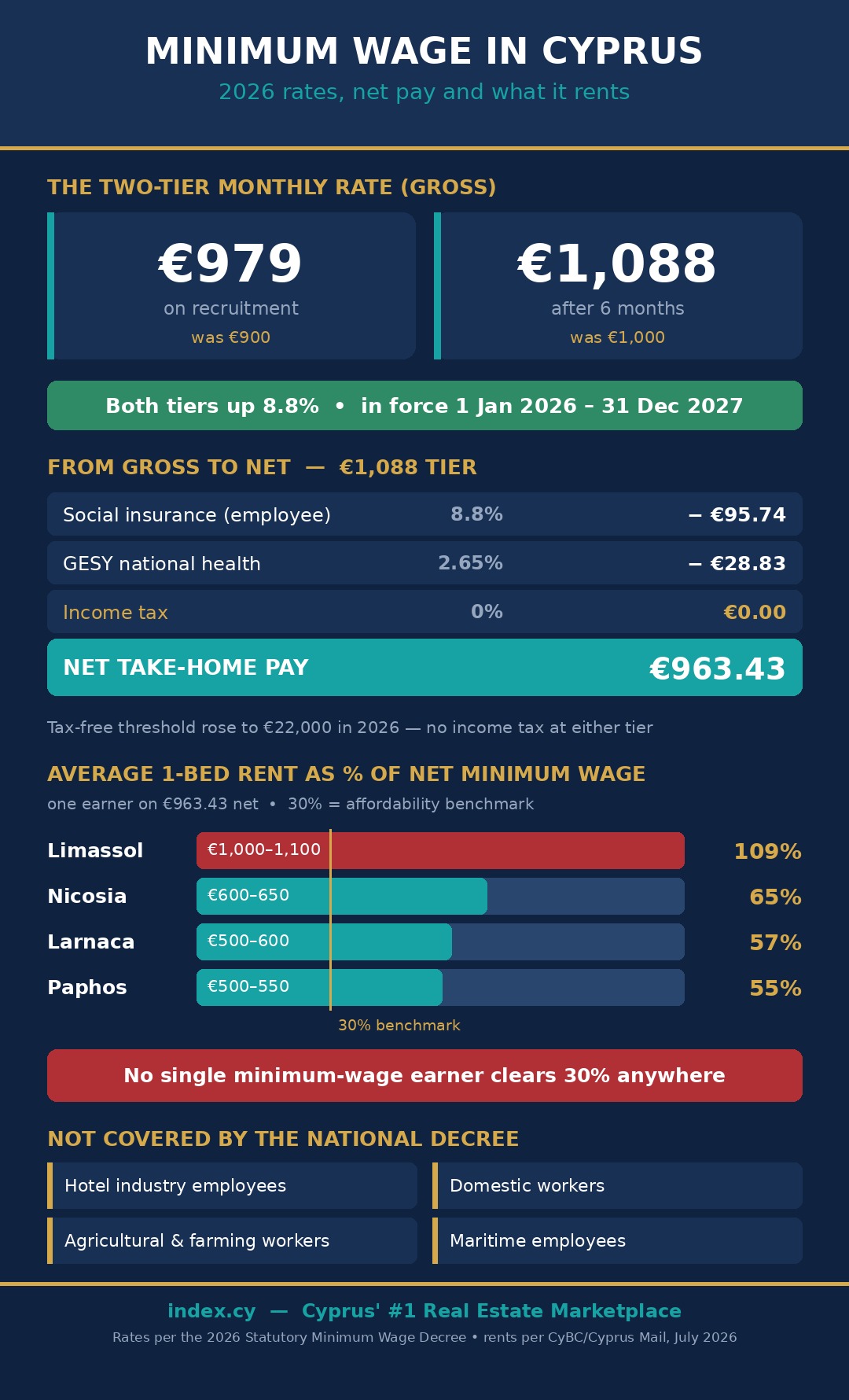
The minimum wage in Cyprus rose on 1 January 2026 to €979 gross per month on recruitment and €1,088 gross after six months with the same employer. Both tiers went up by 8.8% — the largest single adjustment since Cyprus introduced a national statutory minimum wage in 2023.
That is the headline. The more useful question, and the one this guide is built around, is what those figures actually mean once deductions come off and rent goes out. A single earner on the full statutory minimum takes home €963.43 a month. The average one-bedroom apartment in Limassol rents for €1,000–€1,100. The arithmetic there is not subtle.
This guide covers the 2026 rates, who is excluded from them, how gross converts to net, what the wage costs an employer, and how far it stretches against real rents in each district. If you are researching the wider jobs market, our guide to working in Cyprus is the broader pillar; this piece goes deep on the wage floor itself.
This article is general information, not legal, tax or employment advice. Rates and rules change — confirm your own position with the Department of Labour Relations or a qualified adviser.
Cyprus operates a two-tier monthly minimum wage. New hires start on the lower tier and move to the higher one after six months of continuous employment with the same employer.
| From 1 Jan 2026 | Previous (2024–2025) | Increase | |
|---|---|---|---|
| On recruitment | €979 gross/month | €900 gross/month | +8.8% |
| After 6 months’ continuous employment | €1,088 gross/month | €1,000 gross/month | +8.8% |
The rates were set by a Statutory Minimum Wage Decree issued by the Council of Ministers on 23 December 2025 under the Minimum Wage Law (Cap. 183). The decree repeals and replaces the 2023 decrees and is legally binding on all employers within its scope from 1 January 2026 until 31 December 2027, as Harris Kyriakides sets out in its analysis of employer duties.
Three practical points matter more than the headline numbers:
Not as a legal figure. Cyprus sets its minimum wage monthly, and the government has indicated that the possible introduction of an hourly minimum wage remains under discussion within the Technical Committee.
You can derive an approximate hourly equivalent. On a 40-hour week (173.3 hours a month), €1,088 works out to roughly €6.28 an hour and €979 to about €5.65. Treat those as arithmetic, not law — if your contracted week is 38 or 45 hours, the effective rate shifts accordingly.
This is the detail most summaries skip, and it affects a large share of exactly the workers people assume are protected. The national decree does not apply universally. Four categories sit outside it, governed instead by their own regulations or collective agreements. Per RSM Cyprus’s breakdown of the 2026 decree, the excluded groups are:
The exclusions are significant in a tourism-driven economy. Hotel staff — a substantial part of the workforce in Paphos and Famagusta especially — are covered by sectoral collective agreements rather than the national floor. Domestic workers in private households fall under a separate migrant-worker scheme with its own, lower minimum plus board and lodging.
If you work in one of these sectors, the €1,088 figure is not your entitlement. Your terms come from the applicable collective agreement or scheme, and you should check them directly with the Ministry of Labour and Social Insurance.
Employers, meanwhile, always retain the right to offer more favourable terms. The decree is a floor, not a ceiling, and collective agreements in construction, banking and parts of retail sit well above it.
Gross pay is not take-home pay. Two mandatory deductions come off every payslip in Cyprus, and one tax does not.
| Deduction | Rate | On €979 | On €1,088 |
|---|---|---|---|
| Social insurance (employee share) | 8.8% | €86.15 | €95.74 |
| GESY / national health system | 2.65% | €25.94 | €28.83 |
| Income tax | 0% | €0.00 | €0.00 |
| Total deductions | 11.45% | €112.09 | €124.57 |
| Net monthly pay | €866.91 | €963.43 |
Minimum-wage earners in Cyprus pay no income tax at all. The 2026 tax reform raised the personal income tax-free threshold from €19,500 to €22,000, effective 1 January 2026. A full year on the higher tier comes to €13,056 gross — well under half the threshold. Even two minimum wages in one household stay comfortably tax-free.
That is genuinely unusual by European standards, and it means the effective deduction rate on a Cyprus minimum wage is just 11.45%. The trade-off is that social insurance and GESY are not optional: they buy pension accrual, sickness and unemployment entitlement, and healthcare access. Our social insurance guide explains what those contributions actually earn you, and the healthcare guide covers what GESY delivers in return.
For a fuller picture of where that €963 goes each month — utilities, groceries, transport, phone — see our cost of living in Cyprus guide.
Here is where the wage floor meets the property market, and where the numbers get uncomfortable.
In July 2026, the president of the real estate registration council, Marinos Kynigeirou, told CyBC that rental prices remain high across the island even though increases have largely stalled during 2026. His figures give us a clean benchmark to test the minimum wage against.
The standard affordability rule of thumb is that housing should take no more than 30% of net income. Against a net minimum wage of €963.43, here is how that holds up.
| District | 1-bed rent | % of one net minimum wage | % of two net minimum wages |
|---|---|---|---|
| Limassol | €1,000–€1,100 | 109% | 54% |
| Nicosia | €600–€650 | 65% | 32% |
| Larnaca | €500–€600 | 57% | 29% |
| Paphos | €500–€550 | 55% | 27% |
The Limassol row is the one to sit with. The average one-bedroom apartment in Limassol costs more than a full net minimum wage. Not 30% of it, not 60% of it — more than all of it. A single person earning the statutory minimum cannot rent an average one-bedroom in Limassol at any ratio, and the gap is not closeable by cutting other spending.
Nowhere on the island does a single minimum-wage earner reach the 30% benchmark alone. The best case, Paphos, still consumes 55% of net pay.

Two minimum wages in one household changes the picture materially. A dual-earner couple clears the 30% line in Larnaca (29%) and Paphos (27%), sits just above it in Nicosia (32%), and remains stretched in Limassol (54%).
Two-bedroom properties tell the same story with less room. Average rents run €1,400–€1,500 in Limassol, €800–€900 in Nicosia, and €700–€800 in both Larnaca and Paphos — which is 75% of a dual minimum-wage household’s net income in Limassol against roughly 39% in Larnaca or Paphos.
The video above is one household’s account of everyday costs in Cyprus. It was recorded before the January 2026 rates took effect, so treat the wage figures in the tables above as the current ones.
The practical takeaway is that district choice matters more than almost any other variable for anyone at or near the wage floor. The spread between Limassol and Paphos on a one-bedroom is roughly €500 a month — over €6,000 a year, on a wage of €13,056.
That is why a great many lower-income and early-career households commute into Limassol rather than living in it. If you are weighing districts, our guides to living in Larnaca, living in Paphos, living in Nicosia and living in Limassol set out what each actually offers, and our best places to live in Cyprus guide compares them directly.
To see current asking rents rather than averages, browse flats for rent in Cyprus and our property to rent guide. Buyers watching the other side of the same market can check property prices in Cyprus or browse listings in Larnaca, Paphos and Nicosia — including cheaper apartments across the island.
Gross pay is not the employer’s cost either. On top of the €1,088, an employer in Cyprus carries roughly 15.4% in mandatory on-costs:
That adds about €167.55 a month, taking the true cost of a full-tier minimum-wage employee to roughly €1,256 a month, or just over €15,000 a year before any other benefit.
For employers, the 8.8% uplift therefore costs more than 8.8% in absolute terms. The annual gross increase alone is €1,056 per full-tier employee, plus on-costs. Businesses running thin margins on entry-level staff — small retail, food service, cleaning contractors — felt this one.
Cyprus set its 2026 rates as part of aligning with Directive (EU) 2022/2041 on adequate minimum wages. That directive asks member states to assess their wage floor against reference values: commonly 60% of the gross median wage and 50% of the gross average wage.
Cyprus does not currently clear either benchmark.
| Reference point | Figure | €1,088 as % |
|---|---|---|
| Median monthly earnings | €1,968 | ~55% |
| Average monthly earnings | €2,605 | ~42% |
Median and average earnings figures come from Cystat’s 2025 data. Depending on which median series is used, analysts put the ratio somewhere in the 55–58% range — short of the 60% reference either way, though closer than most of the gap-year comparisons suggest.
The rate was not set arbitrarily. A Technical Committee of employer organisations, trade unions and the Ministry of Labour and Social Insurance weighed purchasing power and inflation across 2024–2025, wage and earnings developments, productivity and economic growth, unemployment levels, and the competitiveness of the Cypriot economy.
Two things follow for anyone planning ahead. First, the current decree runs to 31 December 2027, so the next scheduled adjustment lands for 2028 unless the framework changes sooner. Second, Cyprus is still legislating its full transposition of the directive, and the treatment of the 60%/50% reference values in that bill has been actively contested between employer groups and unions. The direction of travel is upward; the pace is a live political question.
€979 gross on recruitment and €1,088 gross after six months of continuous employment with the same employer, effective 1 January 2026.
Automatically, on completing six months of continuous employment with the same employer. No employer action or application is required.
Gross. After 8.8% social insurance and 2.65% GESY, net pay is €866.91 on the lower tier and €963.43 on the higher tier. No income tax is due at either level.
No. The tax-free threshold rose to €22,000 a year from 1 January 2026, and a full year on the higher tier is €13,056.
No. Hotel industry employees, domestic workers, agricultural and farming workers, and maritime employees are excluded from the national decree and covered by their own regulations or collective agreements.
Not as a legal rate. The minimum is set monthly. An hourly equivalent of roughly €6.28 can be derived on a 40-hour week, but it has no independent legal status.
Employment-based residency has its own income and permit requirements that vary by nationality and category. See our guides to the yellow slip, tax residency and relocating to Cyprus for the current framework.
The minimum wage in Cyprus in 2026 is €979 gross on hire and €1,088 gross after six months — an 8.8% rise, with an unusually light 11.45% deduction load and zero income tax thanks to the €22,000 threshold.
What it does not do is close the housing gap. At €963.43 net, a single minimum-wage earner cannot afford an average one-bedroom apartment anywhere in Cyprus at the 30% benchmark, and in Limassol cannot afford one at all. Dual-earner households at the floor reach affordability only in Larnaca and Paphos.
For anyone planning a move, a first job, or a budget, the district decision carries more weight than the wage tier does. Run the rent numbers for your specific district before you commit to anything, and if you are looking at buying rather than renting, our instant property report shows you what a property is actually worth before you make an offer.
Figures reflect published rates as of August 2026 and are provided for general information only. Confirm your own entitlements with the Department of Labour Relations or a qualified employment adviser.