
What this guide covers
- Why Air Conditioning in Cyprus Is Infrastructure, Not a Luxury
- How Many Cyprus Properties Actually Have Air Conditioning?
- What Air Conditioning Costs to Install in Cyprus
- What Air Conditioning Actually Costs to Run in Cyprus
- Does Air Conditioning Add to the Rent? Our Data Says No
- Air Conditioning and Solar Now Travel Together
- The €32,000 Grant Reopening This Month
- What to Check Before You Buy or Rent
- The Bottom Line on Air Conditioning in Cyprus
Air conditioning in Cyprus is not a comfort upgrade. It is the single largest controllable line on a household electricity bill, and on this island it runs hard for four months of the year and ticks over for two more.
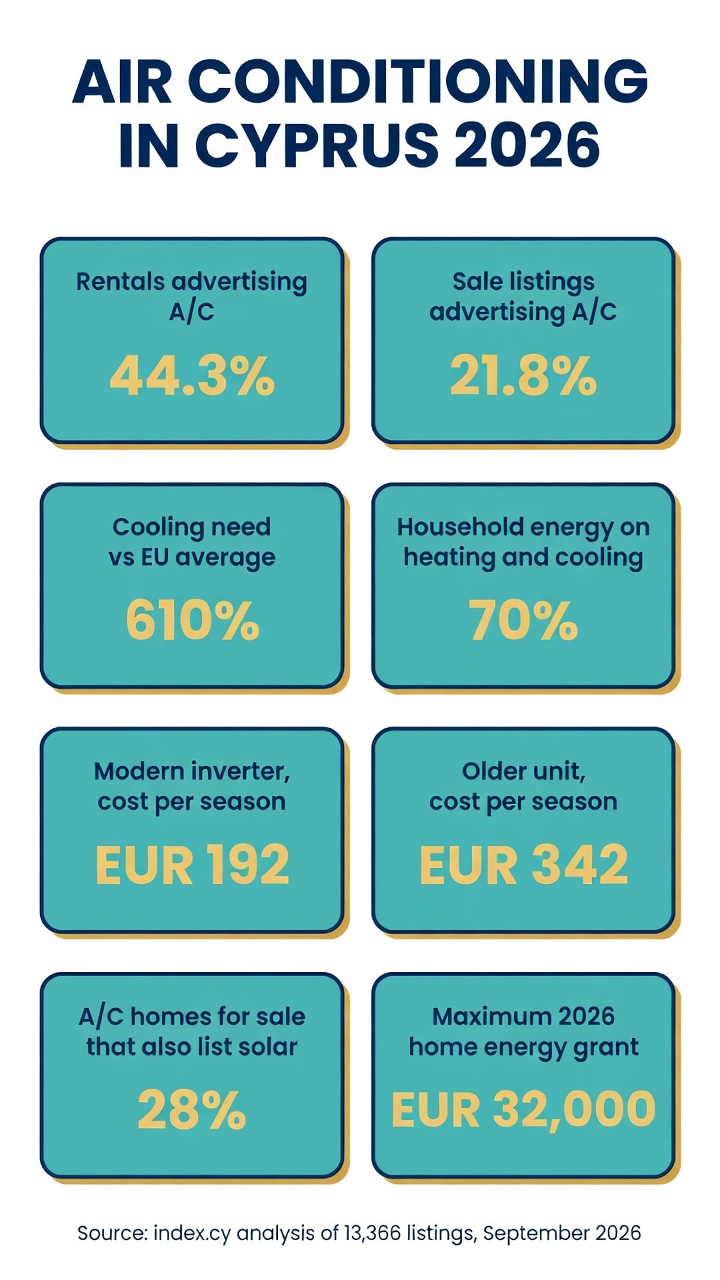
We analysed 13,366 live index.cy listings in September 2026 — 4,658 rentals and 8,708 sale listings carrying a substantive description. 44.3% of rental listings advertise air conditioning against 21.8% of sale listings, a gap of almost exactly two to one. That gap turns out to be the most useful number in this guide, and it is not because tenants get better-equipped homes than buyers.
This guide covers what a split system costs to install in Cyprus, what it costs to run at 2026 electricity prices, whether it earns a landlord any extra rent (our data says no — and the reason will surprise most owners), and how the €32,000 government grant reopening this month changes the arithmetic on replacing an old unit.
We write as Cyprus’ #1 property marketplace, so the focus throughout is practical: what cooling does to the running cost of a home you are about to buy or rent, and what to check before you sign.
Why Air Conditioning in Cyprus Is Infrastructure, Not a Luxury
In most of Europe, cooling is optional. In Cyprus it is the dominant energy story of the year, and the official data is unambiguous about the scale.
A report published in June 2026 by the European Commission’s Joint Research Centre found that heating and cooling account for around 70% of household energy consumption in Cyprus, with cooling degree days reaching 610% of the European average. The mirror image is just as striking: Cyprus records around 81% fewer heating degree days than the EU average. Heat pumps installed here are used primarily for cooling, with cooling demand exceeding heating demand by more than five times.
The building stock was not designed for this. The same report found that 57% of buildings in Cyprus were constructed before 2000, ahead of the introduction of stricter energy performance standards. That is the single most important thing to understand about air conditioning costs on this island: in an uninsulated 1990s apartment, the unit is fighting the building.
You can see the aggregate effect on the national grid. In July 2026 the transmission system operator reported that demand peaked at 1,156 megawatts at 2.30pm and was still 921 megawatts at 8pm, with maximum summer demand forecast at between 1,260 and 1,300 megawatts. Renewables covered roughly 70% of production for many hours in the middle of the day, but only 40 to 50 megawatts overnight — which is why the evenings, when the air conditioning is still running and the sun has gone, are the hours the operator watches most closely.
How Many Cyprus Properties Actually Have Air Conditioning?
Nobody publishes this figure, so we measured it. We read the description of every English-language listing on index.cy in September 2026 and recorded whether it advertises air conditioning of any kind — split units, VRV or VRF systems, ducted, or a generic mention of A/C.
One caveat first, and it matters. A listing that does not mention air conditioning is not necessarily a property without it. These are marketing descriptions, not surveys. What the numbers below measure is how often the feature is worth advertising — which turns out to be a more interesting question than raw penetration.
| District | Rental listings | % advertising A/C | Sale listings | % advertising A/C |
|---|---|---|---|---|
| Limassol | 3,139 | 40.8% | 4,189 | 23.7% |
| Nicosia | 502 | 51.6% | 482 | 31.5% |
| Larnaca | 422 | 57.6% | 1,637 | 19.2% |
| Paphos | 236 | 38.1% | 1,742 | 19.4% |
| Famagusta | 33 | 57.6% | 293 | 15.0% |
| All Cyprus | 4,658 | 44.3% | 8,708 | 21.8% |
The district rows sum to 4,332 rentals and 8,343 sale listings. The residual — 326 and 365 respectively — is made up of listings whose URL carries no district, so they count towards the national totals but cannot be assigned to a district. The Famagusta rental sample is only 33 listings and should be read as indicative rather than firm.
Three findings stand out.
Rentals advertise air conditioning twice as often as sales. A tenant is buying a running cost for twelve months; a buyer is acquiring an asset they can retrofit for under €1,000 a room. Cooling is therefore a letting feature far more than it is a selling feature, and landlords behave accordingly.
Nicosia leads on both sides of the market — 51.6% of rentals and 31.5% of sale listings, the highest sale figure of any district. The capital sits inland with no sea breeze, and its July and August daily highs run several degrees above the coast. If you are weighing districts, read this alongside our guide to living in Nicosia and our Limassol guide.
Heating tracks the opposite pattern. Among residential sale listings, 28.1% in Nicosia mention a heating system, against 20.3% in Limassol, 18.2% in Paphos, 4.0% in Larnaca and 2.3% in Famagusta. Coastal Larnaca and Famagusta homes are effectively cooling-only properties — which means the air conditioning unit is the entire climate system, and a failure in August is not an inconvenience.
What Air Conditioning Costs to Install in Cyprus
The standard installation on this island is the wall-mounted split system: an indoor unit in the room, a condenser outside, connected by refrigerant lines. Multi-split systems run several indoor units off one condenser, and VRV or VRF systems serve whole buildings. For a typical apartment or house, you are pricing individual splits, one per room you actually want cooled.
| Item | Typical Cyprus cost (incl. 19% VAT) |
|---|---|
| Split inverter unit, equipment only | €400 – €1,100 |
| Installation labour, straightforward run | €150 – €300 |
| All-in per room | €550 – €1,400 |
| Multi-split, one condenser + 3 indoor units | €2,200 – €4,500 |
| Annual service and filter clean, per unit | €40 – €80 |
| Re-gas or refrigerant top-up | €60 – €120 |
Cost drives on the installation side, not the box. A condenser that has to go on a roof, a long pipe run through finished walls, or a listed or shared façade with management-committee rules all push the labour towards the top of the range. In a new-build the developer runs the pipework during construction and the marginal cost is far lower — one reason cooling appears more often in newer stock. If you are building a house in Cyprus or costing a prefab build, specifying the pipework at shell stage is the cheapest air conditioning decision you will ever make.
Sizing is the other place people lose money. An undersized unit runs flat out and never reaches setpoint; an oversized one short-cycles, which is both inefficient and hard on the compressor. As a working rule for Cyprus conditions, allow roughly 100–130 watts of cooling capacity per square metre of floor area, then add for west-facing glazing, top-floor ceilings and open-plan layouts.
| Room size | Typical capacity | Common rating |
|---|---|---|
| Up to 15 m² (bedroom) | 2.0 – 2.6 kW | 9,000 BTU |
| 15 – 25 m² (large bedroom, small living room) | 3.5 kW | 12,000 BTU |
| 25 – 40 m² (living room) | 5.0 – 5.3 kW | 18,000 BTU |
| 40 – 60 m² (open-plan) | 7.0 kW+ | 24,000 BTU |
What Air Conditioning Actually Costs to Run in Cyprus
This is the number that matters, and it is the one no supplier quotes you. Household electricity in Cyprus costs roughly 25 to 32 euro cents per kilowatt-hour all-in once energy, network charges, the fuel adjustment, public service levies and VAT are combined — the full breakdown is in our guide to electricity in Cyprus and EAC tariffs. The figures below use the midpoint of 28.5 cents.
We model two units doing the same job: a modern A+++ inverter split rated at 3.5 kW of cooling, drawing an average of 0.70 kW while running in Cyprus summer conditions, and an older non-inverter unit of the same capacity averaging 1.25 kW. The usage assumption is eight hours a night — the realistic pattern for a bedroom unit in July and August.
| Modern A+++ inverter | Older non-inverter | |
|---|---|---|
| Average draw while cooling | 0.70 kW | 1.25 kW |
| Cost per hour | €0.20 | €0.36 |
| One month at 8 hours a night | 168 kWh — €47.88 | 300 kWh — €85.50 |
| Four-month season (960 hours) | 672 kWh — €191.52 | 1,200 kWh — €342.00 |
| Season difference | — | +528 kWh, +€150.48 |
Scale that to a whole home and the numbers get serious. A three-bedroom house running three units for a combined 1,800 hours across the season costs about €359 on modern inverters and €641 on older units — a €282 difference for exactly the same comfort. Add a pool pump and the summer bill moves again; our swimming pool guide covers that side of the running cost.
At the ends of the electricity price range, the same 960-hour season costs €168 (modern) against €300 (old) at 25 cents per kWh, and €215 against €384 at 32 cents. Efficiency matters more when power is expensive — and Cypriot power is expensive.
The replacement decision. At €150 of annual saving, a €900 all-in replacement pays for itself in about six cooling seasons on a single bedroom unit. That is a slow payback on its own, which is why replacing a working unit rarely makes financial sense in isolation. It makes a great deal of sense when the old unit is already failing, when you are replacing three at once, or when a grant covers part of the cost — which brings us to the scheme reopening this month.
Two operating habits are worth more than most hardware upgrades. Every degree you drop the setpoint adds roughly 6–8% to consumption, so running at 25–26°C rather than 21°C is the cheapest saving available. And a clogged filter can add 20–30% to cooling costs, which makes an annual service at €40–€80 per unit pay for itself inside one summer.
Does Air Conditioning Add to the Rent? Our Data Says No
Landlords generally assume that fitting air conditioning lets them ask more. We tested it directly. Matching listings within the same district and the same bedroom count — so that geography and size cannot distort the comparison — produces a consistent and counterintuitive result.
| Market | With A/C (median) | Without A/C (median) | Difference |
|---|---|---|---|
| Limassol 2-bed apartment | €2,000 (n=365) | €2,200 (n=495) | −€200 (−9.1%) |
| Limassol 3-bed apartment | €2,700 (n=214) | €3,000 (n=311) | −€300 (−10.0%) |
| Nicosia 3-bed apartment | €1,475 (n=56) | €1,800 (n=48) | −€325 (−18.1%) |
| Larnaca 2-bed apartment | €1,200 (n=114) | €1,300 (n=83) | −€100 (−7.7%) |
In every matched pair, listings that advertise air conditioning ask less than listings that do not. Air conditioning obviously does not reduce the value of a home, so something else is going on — and the quartile data shows exactly what.
Split Limassol’s two-bedroom rental market into four price bands and the pattern is clear. In the cheapest quartile (median €1,600) 42.3% of listings advertise A/C; in the second (€1,900) 48.4%; in the third (€2,500) 42.3%; and in the most expensive quartile (median €4,000) just 36.7%. The higher the rent, the less likely the listing is to mention air conditioning at all — because at €4,000 a month it is assumed, and the description is spent on sea views, the marina and the building’s facilities instead.
We checked the obvious alternative explanation and it does not hold. Median description length is 778 characters for listings mentioning A/C and 754 for those that do not — near-identical, so this is not simply a case of longer adverts listing more features.
The practical conclusion for landlords is the same one our analysis of furnishing costs reached: fit air conditioning to let the property quickly, not to charge more for it. In a market where nearly half of all rentals advertise cooling, not having it removes you from consideration long before the price is discussed. One empty month on a €2,000 two-bedroom apartment costs more than the entire running-cost difference between an old unit and a new one over four summers. Our buy-to-let guide and long-term rental guide cover the void-cost arithmetic in more detail.
Air Conditioning and Solar Now Travel Together
The most striking cross-tabulation in our dataset has nothing to do with price. Among 6,999 residential sale listings, photovoltaic panels appear in 28.0% of listings that advertise air conditioning against 6.1% of those that do not — a factor of 4.6.
That is not a coincidence of wealth. Cooling load and solar generation peak at the same hours: a Cyprus air conditioner works hardest between roughly 11am and 6pm, precisely when a rooftop array is producing most. Owners who install one increasingly install the other.
The economics of that pairing changed in January 2026, when Cyprus replaced net metering with a net billing regime for new installations. Under net metering, every exported kilowatt-hour earned a one-for-one credit. Under net billing, exports are paid at the lower wholesale rate while imports are still bought at retail — so the value now sits in consuming your own generation rather than banking it. A household that runs air conditioning through the afternoon is close to the ideal net billing customer. Our solar panels in Cyprus guide works through the full payback under the new rules.
For buyers, this is a concrete thing to look for. A property with both a modern inverter system and a correctly sized array has a materially lower running cost than an identical property without them, and that difference compounds over every summer you own it — but, as the rent data above shows, it is rarely priced into the asking figure.
The €32,000 Grant Reopening This Month
If you own an older Cyprus home with tired cooling, the timing of this article is not accidental. The government’s third Save–Upgrade Homes call opens for applications in September 2026.
The energy ministry announced in May that it would accept proposals from September with a €20 million budget, bringing the total allocated through the Thalia programme to €85 million. Energy Minister Michael Damianos said the plan provides financial support of up to €32,000 per house, depending on the type of investment.
- Eligible works include thermal insulation, window frames, shading systems, heating and cooling systems, solar water heating, photovoltaics and the associated specialist services.
- Eligible homes are existing dwellings built before 1 January 2008, with an existing electricity account on a residential tariff.
- Enhanced funding — an extra 20% — applies to vulnerable households, mountain area residents and refugee settlements.
- Faster processing — low-risk applications can now be approved without an on-site inspection, after delays in the previous round.
The pre-2008 cut-off is well chosen for this purpose. It captures most of the 57% of Cypriot buildings that predate the 2000 energy standards, which are precisely the properties where an efficient unit has the most work to do. Full conditions are published on the government funding programmes portal, and the scheme operates a helpline on 17107.
The grant is what turns the replacement maths from marginal to obvious. A six-season payback on a full-price unit becomes two or three when a meaningful share of the cost is covered — and the insulation and shading works funded alongside it reduce the load the unit has to meet in the first place.
What to Check Before You Buy or Rent
Air conditioning is one of the few property features where a ten-minute inspection tells you almost everything. Whether you are viewing a rental or a purchase, work through this list:
- Count the units against the rooms. A three-bedroom home with one living-room split is a three-bedroom home with one cooled room. Ask which rooms are actually served, not how many units exist.
- Check the age and the label. The energy label on the indoor unit gives the SEER rating. On our model above, an older non-inverter unit costs roughly 80% more to run than a current A+++ model for identical output.
- Run it. Switch every unit on during the viewing. Listen for rattling, check the airflow is cold within a couple of minutes, and look for water staining on the wall beneath the indoor unit — a sign of a blocked condensate drain.
- Find the condenser. Outdoor units on a shared façade or roof may need management-committee consent to replace or relocate. In an apartment block, ask before you assume you can add one.
- Ask for a summer bill. A July or August EAC bill tells you more about the real running cost of the building than any specification sheet. Sellers and landlords with efficient homes are usually happy to show one.
- Look for the pairing. Photovoltaics, solar water heating and double glazing alongside the units signal an owner who has actually managed the energy performance of the property rather than bolting on cooling as an afterthought.
For anything structural — condensate routing through walls, evidence of damp behind an indoor unit, or an electrical supply that predates the load — our property inspection service covers it as part of a full survey, and the instant property report gives you a data-backed view of what the property should cost before you make an offer.
The Bottom Line on Air Conditioning in Cyprus
Air conditioning in Cyprus costs €550 to €1,400 per room to install and, on a modern inverter, about €192 a season to run against €342 for an older unit. Nearly half of all rental listings advertise it and barely a fifth of sale listings do — not because buyers get worse homes, but because cooling is a letting feature that pricier properties stop bothering to mention.
For tenants, that means treating the units as a running cost to inspect rather than a bonus to be grateful for. For landlords, it means fitting cooling to let quickly rather than to charge more. For owners of pre-2008 homes, it means the grant round opening this month is the cheapest opportunity in years to replace tired units and cut the load they have to meet.
Browse apartments to rent across Cyprus, apartments for sale, houses and villas on index.cy, or read our cost of living in Cyprus guide to see where cooling sits against rent, groceries and transport. If you are planning a move, our relocation guide and guide to buying a house in Cyprus cover the rest of the checklist.
Keep reading

We analysed 217 Erimi, Limassol listings: 105 apartments, 81 houses and 24 plots. Median 2-bed flat EUR295,000. See prices, the repeat-advert trap…

We analysed 319 Aglantzia, Nicosia listings: 155 apartments, 34 houses and 38 plots. Median 2-bed costs EUR257,500. See prices, rents and what…

We analysed 387 Egkomi (Engomi), Nicosia listings: 169 apartments, 73 houses and 99 rentals. Median 2-bed costs EUR285,000. See prices, rents and…