
Ask ten people in Limassol whether you can drink the tap water in Cyprus and you will get ten different answers. Some fill a glass straight from the kitchen sink. Others have not touched it in twenty years and buy 19-litre bottles by the crate. Both groups are convinced they are right.
The confusion is understandable, because the honest answer has two halves. Tap water in Cyprus is treated to European Union drinking-water standards, monitored continuously, and microbiologically safe in the government-controlled areas. It is also among the hardest water in Europe, tastes strongly of minerals, and arrives through a supply system that is 80 per cent desalinated and recovering from the worst drought in the island’s recorded history.
For anyone buying or renting a home here, that second half matters more than the first. Hard water quietly destroys boilers and washing machines. Drought shapes what you can do with a garden or a pool. And the water account is one of the few utilities that does not transfer automatically when you take over a property — unlike electricity and the EAC, which most new arrivals plan for.
This guide covers what is actually in Cyprus tap water, where it comes from, what the latest 2026 reservoir figures look like, what you will pay, and the specific water questions worth asking before you sign anything.
Yes. In the Republic of Cyprus, mains tap water is treated and distributed to standards set by the That last point is the one worth remembering, because it is the only one you can actually do something about as a property owner. The mains supply is the state’s responsibility. Everything past the meter is yours. This guide covers the government-controlled areas of the Republic of Cyprus. Water quality and infrastructure in the north differ, and bottled water is more commonly advised there. Cyprus has no rivers that flow year-round. Every drop of mains water starts as either rainfall captured behind a dam, groundwater from a borehole, or seawater pushed through a reverse-osmosis membrane. The balance between those three has shifted dramatically. According to the Water Development Department, desalinated water now covers roughly 80 per cent of Cyprus’ total water needs, with daily production from all units reaching around 245,000 cubic metres. Five permanent desalination plants operate at Dhekelia, Larnaca, Vasiliko, Episkopi and Paphos, supported by mobile units at Kissonerga and Moni, with further mobile capacity added at Kato Polemidia and the port of Limassol. Reservoir water is moved around the island by the Southern Conveyor, a pipeline network built in phases from the 1980s that collects surplus water in the south-west and carries it eastward to supply Limassol, Larnaca and Famagusta, along with industry and agriculture. Two things follow from this that are rarely spelled out. Your tap water is largely industrial output, not mountain runoff. That is why supply has held up through a historic drought — desalination does not care whether it rained. It is also why water policy in Cyprus is now an energy question. The island’s desalination plants produce over 550,000 tonnes of CO₂ a year and are projected to consume around 700 gigawatts by 2030, which is part of why household efficiency measures have moved up the national agenda. If you are weighing up running costs on a property, our guides to electricity costs and EAC tariffs and solar panels in Cyprus cover the other side of the same equation. A large volume is lost before it reaches anyone. Ecologists Movement MP Charalambos Theopemptou has highlighted network losses of up to 40 per cent from ageing infrastructure, arguing that pipe repair deserves as much attention as new production capacity. That is a fair criticism, and it is worth knowing that some of what you pay for never arrives. Cyprus entered 2026 in a genuine emergency. In February, reserves fell to under 14 per cent of capacity — the lowest since hydrological records began in 1901 — and residents were asked to cut consumption by 10 per cent. By March, dam levels were still only around 21 per cent. Then it rained. The recovery through spring and summer has been substantial, and the position as of late August 2026 is materially better than a year ago. Source: Water Development Department figures, reported 24 August 2026. MCM = million cubic metres. Seventeen of the island’s eighteen reservoirs now hold more water than they did a year ago; the single exception is Achna. Kalopanayiotis is the fullest by percentage but holds just 0.3 MCM, which is a useful reminder that headline percentages and actual volumes tell different stories. This report was filmed during the depths of the drought and predates the 2026 recovery — see the table above for the current Water Development Department figures. What this means in practice. Storage at 38 per cent after four consecutive drought years is a recovery, not a resolution. Desalination is what keeps taps running regardless, so a repeat dry winter is unlikely to cut off household supply. What it does affect is everything at the margins: irrigation allocations for farmers, restrictions on filling private pools, garden watering rules, and the pricing signals that follow. If you are buying a property with significant outdoor water demand, treat the drought as a structural feature of the island rather than a passing event. Our reporting on how the water crisis is reshaping Cyprus real estate, on national water conservation measures and on the acceleration of desalination projects tracks how this is playing out. If there is one water issue that costs Cyprus homeowners real money, it is not safety. It is hardness. Cyprus tap water averages around 341 mg/L of calcium carbonate, which sits firmly in the “very hard” band on the standard scale. Typical readings across the districts fall somewhere between 250 and 400 ppm. The island’s limestone geology is the underlying cause: water picks up calcium and magnesium as it moves through the rock, and desalinated water is remineralised on the way out of the plant. Hard water is not a health risk. Dissolved calcium and magnesium are dietary minerals, and no European regulator treats hardness as a safety parameter. The cost shows up somewhere else entirely: when hard water is heated, those minerals precipitate out as limescale, and limescale is exceptionally good at ruining appliances. What owners actually do about it. The mainstream fix is a whole-house water softener plumbed in after the meter, typically an ion-exchange system that swaps calcium and magnesium for sodium. Point-of-use filters — jug filters, under-sink units, reverse-osmosis taps — address taste and are what most households use for drinking, but they do nothing to protect appliances elsewhere in the property. A softener protects the plumbing; a filter improves the glass. They are not substitutes for each other. Two practical notes for buyers. First, if a property already has a softener installed, ask when it was last serviced and whether salt has been kept topped up — a neglected softener is just an expensive obstruction. Second, factor descaling and eventual appliance replacement into your running-cost estimate alongside electricity, home insurance and internet. Our full breakdown of the cost of living in Cyprus puts these numbers in context. Water in Cyprus is not billed by a single national utility. Electricity has the EAC; water does not have an equivalent. Supply is administered locally by district organisations, water boards and municipalities, which means tariffs, deposits and procedures genuinely differ depending on where the property sits. Anyone quoting you a single island-wide water price is simplifying. What is broadly consistent: As a planning figure, consumption charges commonly fall in the region of €0.64–€1.00 per cubic metre in the lower bands, with sewerage adding roughly €0.60 per cubic metre on top. That puts an all-in cost near €1.50 per cubic metre for a typical household band — but treat this as an order-of-magnitude estimate only, and replace it with the published rate sheet from the authority that actually serves your address. This is where new arrivals get caught out. Water accounts do not follow the property automatically. To put the account in your name you generally need identification, proof that you own or rent the property, and often a meter reading or photograph. Outstanding bills on the account must normally be settled before it can be transferred, and the account can typically only be held by the owner or the tenant — not a third party. Expect a refundable deposit, and expect it to be meaningfully higher for tenants than for owners, particularly for third-country nationals. New connection fees are a separate cost again. The Nicosia district organisation publishes its water supply procedures online, and other districts operate comparable systems. The practical lesson: check the water account status before completion, not after. An unpaid balance left by a previous occupant is a problem you inherit at the counter. This belongs on the same checklist as the rest of your due diligence when buying property in Cyprus, alongside title deeds and the full cost of buying property in Cyprus. Water rarely appears on a standard viewing checklist, which is precisely why it is worth adding. The following six checks take minutes and can save years of irritation. A professional survey will cover plumbing condition in far more depth than a viewing allows, and it is the point at which tank, pressure and pipework problems usually surface. If you want an independent read on a specific property before committing, index.cy offers a property inspection service and an instant property report that put the fundamentals in front of you before you make an offer. The mains supply meets the same national standards everywhere in the government-controlled areas, so this is not a quality ranking. It is a note on supply mix and local context, which does vary. If you are still deciding where to base yourself, our comparison of the best places to live in Cyprus weighs these factors alongside prices, schools and commute times, and our expat guide to living in Cyprus and relocation guide cover the wider move. Yes. In the Republic of Cyprus, mains tap water is treated to EU Drinking Water Directive standards and monitored by the Water Development Department and the State General Laboratory. It is microbiologically safe. Most residents still drink filtered or bottled water by preference, largely because of taste and hardness rather than any safety concern. Because roughly 80 per cent of it is desalinated seawater that has been remineralised, and because the mineral load is high. Chlorination adds to this. A simple carbon jug or under-sink filter removes most of the taste complaint at low cost. Very. It averages around 341 mg/L of calcium carbonate, well inside the “very hard” classification, with district readings typically between 250 and 400 ppm. Expect limescale in kettles, shower heads and — more expensively — water heaters and washing machines. Yes, on both counts. The water meets drinking-water standards, so brushing teeth, washing food and cooking with it are all fine. Households that dislike the taste often use filtered water for cooking simply because it affects the flavour of tea, coffee and stock. Not in the sense of taps running dry. Cyprus went through its worst drought on record, with reserves under 14 per cent in February 2026, but roughly 80 per cent of supply now comes from desalination, which is independent of rainfall. Reserves recovered to 38.2 per cent of capacity by late August 2026. The real pressure falls on agriculture, irrigation and outdoor water use rather than on domestic drinking supply. They solve different problems. A filter improves the taste of drinking water at one tap. A softener treats the whole property and protects boilers, washing machines and pipework from limescale. If you own rather than rent, the softener is the one that pays for itself. Contact the water authority for that specific area — a district organisation, water board or municipality depending on location. You will typically need ID, proof of ownership or a tenancy agreement, a meter reading, and settlement of any outstanding balance. A refundable deposit is normally required, and it is usually higher for tenants than for owners. If you are renting rather than buying, our guide to property to rent in Cyprus covers what else the landlord should hand over. You can drink the tap water in Cyprus. That question, which is what most people arrive asking, has a short and unambiguous answer: the mains supply meets EU standards and is monitored accordingly. The more useful questions are the ones underneath it. Cyprus tap water is very hard, and that hardness will cost you money through appliances long before it ever affects your health. Eighty per cent of your supply is manufactured rather than collected, which makes it drought-resilient but energy-intensive. Reservoirs have recovered to 38.2 per cent after a genuinely historic dry spell, and outdoor water use is where the remaining pressure lands. And the water account is a local matter that will not sort itself out on completion day. For buyers, the takeaway is narrow and practical: ask about the tank, test the pressure, check the account, and price in a softener if the property does not already have one. None of these are deal-breakers. All of them are cheaper to discover before you sign than after. Ready to look? Browse houses, villas and apartments for sale in Cyprus on Cyprus’ largest verified property database, compare property prices across the island, or start with our guide to buying property in Cyprus as a foreigner if this is your first purchase here.Where Cyprus Tap Water Actually Comes From
Cyprus Reservoir Levels in 2026: The Drought in Numbers
Reservoir / group Storage (Aug 2026) % of capacity Year-on-year All reservoirs (island-wide) 111 MCM 38.2% up from 43.9 MCM / 15.1% Kouris (largest dam) 45.3 MCM 39.4% roughly triple last year Asprokremmos (2nd largest, Paphos) 20 MCM 38.4% up Southern Conveyor dams (combined) — 35.7% up Paphos district reservoirs — 28.9% up from 10.1% Kalopanayiotis (Nicosia district) 0.3 MCM capacity 99.4% highest fill rate 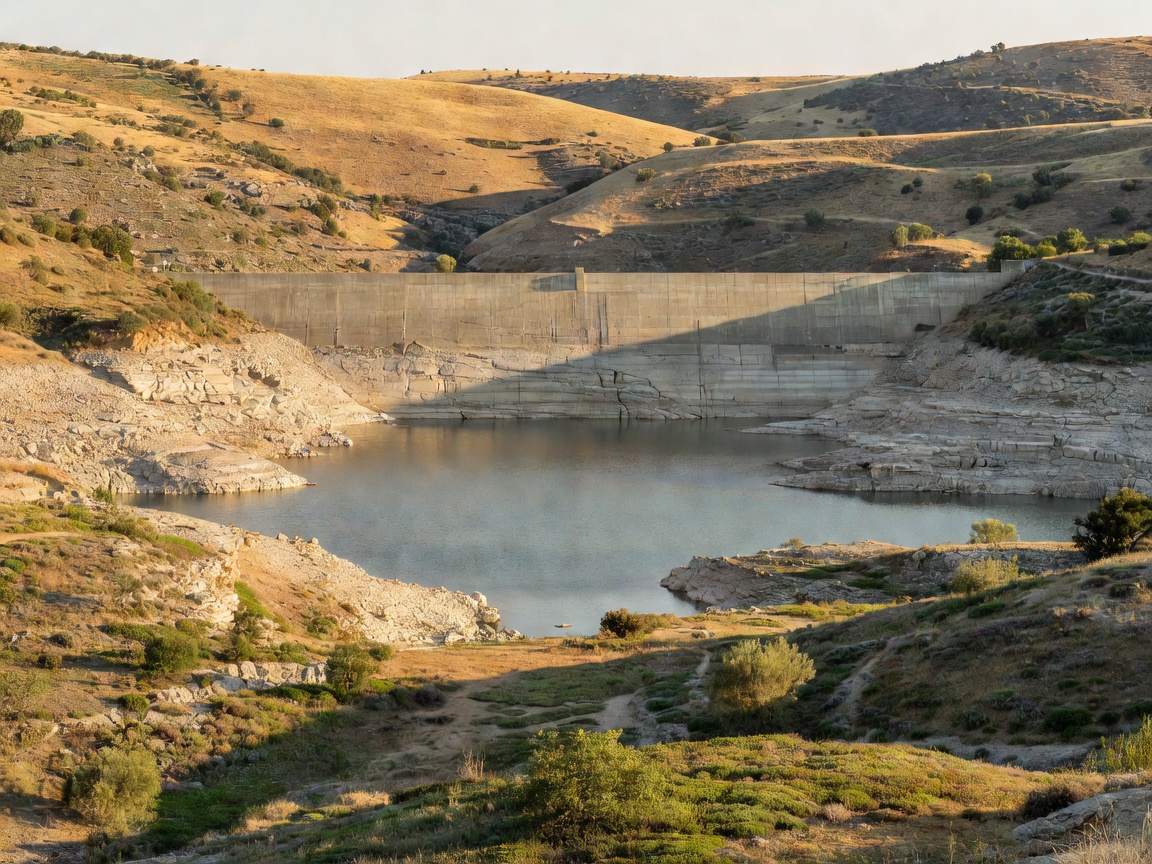
Hard Water in Cyprus: The Real Problem for Property Owners
Hardness (mg/L CaCO₃) Classification Where Cyprus sits 0–60 Soft — 61–120 Moderately hard — 121–180 Hard — 181 and above Very hard Cyprus ≈ 341 mg/L 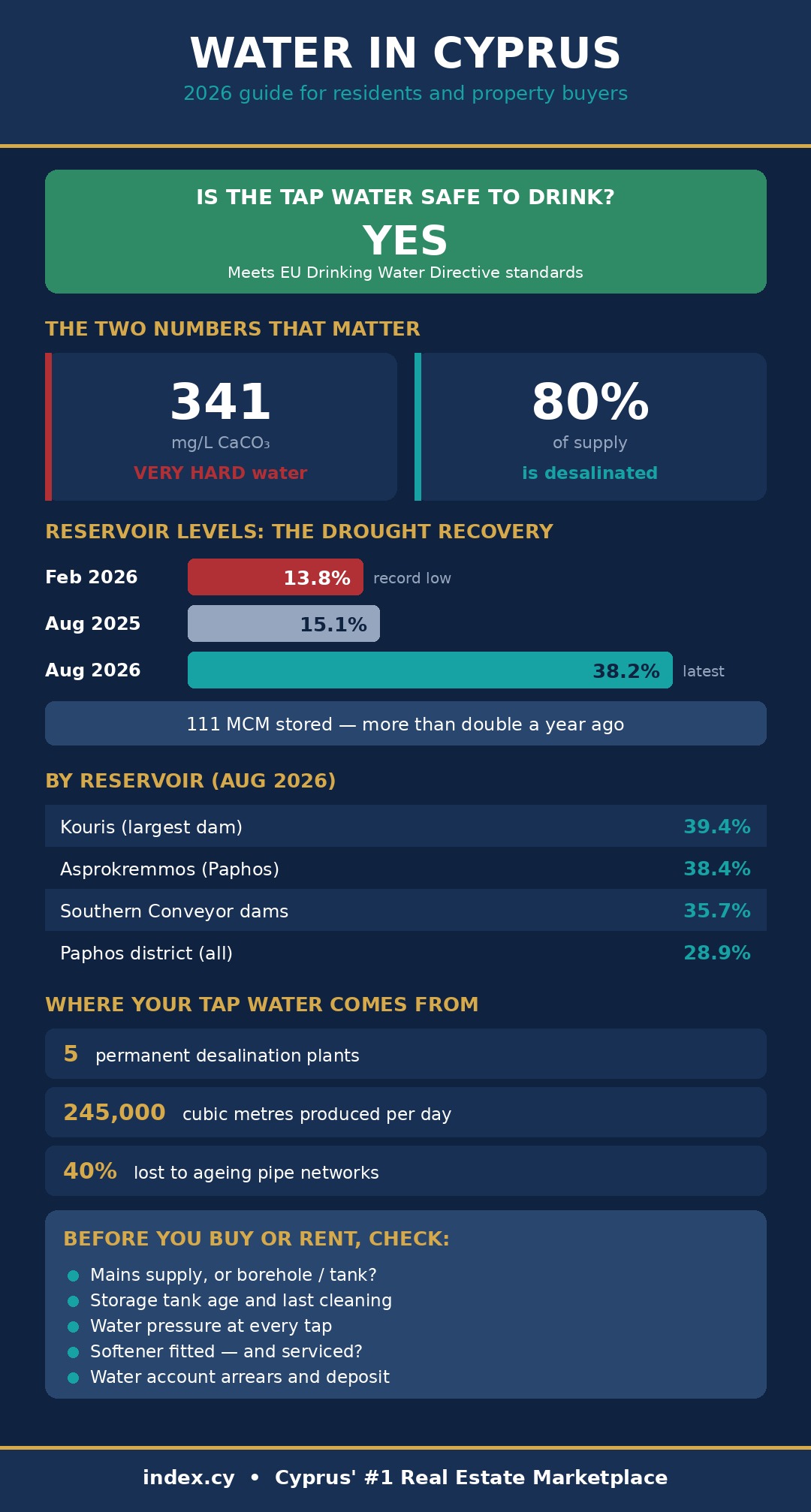
What Water Costs in Cyprus: Bills, Tariffs and Connection
Transferring the water account when you move in
Water Questions to Ask Before You Buy or Rent
Water by District: What to Expect
Frequently Asked Questions About Tap Water in Cyprus
Can you drink tap water in Cyprus safely?
Why does Cyprus tap water taste strange?
Is Cyprus tap water hard?
Can you brush your teeth and cook with Cyprus tap water?
Is Cyprus running out of water?
Do I need a water filter or a water softener in Cyprus?
How do I transfer the water account when I move into a Cyprus property?
The Bottom Line on Tap Water in Cyprus